



Received: 20 Sep 2025; Accepted: 22 Jun 2025
Symmetric cubic polynomials
(Date: September 20, 2024; revised May 23, 2025)
 Abstact.
 Abstact.
 1 Introduction
A central problem of Complex Dynamics is to describe parameter spaces of holomorphic maps. Investigating the deceptively simple quadratic family led to an explosion of activity in the field. Aided by computer graphics capabilities, mathematicians made many interesting discoveries concerning the connectedness locus of the quadratic family, the celebrated Mandelbrot set .
One of the first such discoveries, made by Douady and Hubbard [15], was that is connected. Then the combinatorial description of the structure of the Mandelbrot set was largely carried out in the language of laminations introduced by Thurston [41] (see Section 3 and [41] or [6] for precise definitions and other details). Douady constructed a topological pinched disk model of ; Thurston made this model more explicit and described it in terms of laminations. If is locally connected (which is still an open question), then it is homeomorphic to its model. The local connectivity of the Mandelbrot set is one of the most important long standing conjectures in the field; if true, it will imply the density of hyperbolicity property of the quadratic family.
The above describes the quadratic version of what one can call the Douady–Hubbard–Thurston program, i.e. a two step approach to studying some complex one-dimensional parameter space of polynomials that we now fix. Similar to the quadratic family, its most interesting part is the connectedness locus, i.e., the locus of all polynomials in the space with connected Julia sets (in the quadratic case, this is the Mandelbrot set). One needs to prove that the connectedness locus is connected itself. Then two steps are made. On the first step one describes the laminations of the polynomials from the parameter space in question producing in the end the corresponding space of laminations, most likely described itself by a certain parameter lamination (like, e.g., Thurston’s QML lamination [41]). On the second step one constructs a monotone map from the connectedness locus of interest to the quotient space of the closed unit disk under the parameter lamination. This quotient space can be viewed as a model for the connectedness locus.
The Douady–Hubbard–Thurston program has been implemented for quadratic polynomials, and then for unicritical polynomials of any degree , cf. [1, 22, 38, 39], where is the parameter.
We initiated this program for the space of symmetric cubic polynomials with marked critical point in papers [8, 9] that serve as a prequel to the present article. Namely, in [8] we investigated the space of symmetric cubic laminations and constructed the associated parameter lamination called the cubic symmetric comajor lamination (see Section 3). In [9] we proved an analog of Lavaurs algorithm for this lamination. Now, let be the connectedness locus of . The aim of the present article is to complete the program for the space and prove the following theorem.
The set is a full continuum. There exists a monotone continuous surjective map . If is locally connected, then is a homeomorphism.
We are not aware of any other articles in which the Douady–Hubbard–Thurston program is fully implemented for non-unicritical polynomials. We did recently learn of a manuscript by Xavier Buff [12] in which he studies the parameter space of symmetric polynomials of the form and shows that the connectedness locus contains the unit disk and that every component of is homeomorphic to a limb of the Mandelbrot set.
Acknowledgments. Some figures in the article have been produced with a modified version of Mandel, a software written by Wolf Jung. The authors are grateful to the reviewer for careful reading and useful suggestions.
2 Notation and preliminaries We assume knowledge of basic facts and concepts of complex dynamics. We also use standard notation (such as for the Julia set of a polynomial , etc).
Consider the space of symmetric cubic polynomials with marked critical point , or, more formally, the space of pairs , which, in turn, is uniquely parameterized by the values of . Since , every polynomial (except for ) shows in twice. Thus, is a (branched) two-to-one cover of the moduli space of all odd cubic polynomials, where the moduli space means the quotient space with respect to complex linear conjugacy. The critical points of are and , the corresponding critical values are and . The marked cocritical point of , i.e., the other preimage of , is . Subsets and of the plane are said to be mutually symmetric if . If we call a set symmetric. Since is odd, the Julia set the filled Julia set , and their complements are symmetric. Observe that and .
Let be the connectedness locus of , i.e., the set of all for which the Julia set of is connected. It is known that the Julia set of is connected if and only if all forward orbits of critical points of are bounded. Since has mutually symmetric critical orbits, we conclude that if and only if the orbit of or, equivalently of or , is bounded.
For any set , and write for . Let be the unit circle. For a set , let be its closure and be its boundary. We use the terms periodic orbit and cycle interchangeably. External rays to the Julia set of a polynomial are denoted where is the argument of the ray (if there is no ambiguity we may omit the polynomial from our notation; also, we write instead of ).
Let , be topological spaces and be continuous. Then is said to be monotone if is connected for each . It is known that if is monotone and is a continuum then is connected for every connected .

 3 Symmetric cubic laminations
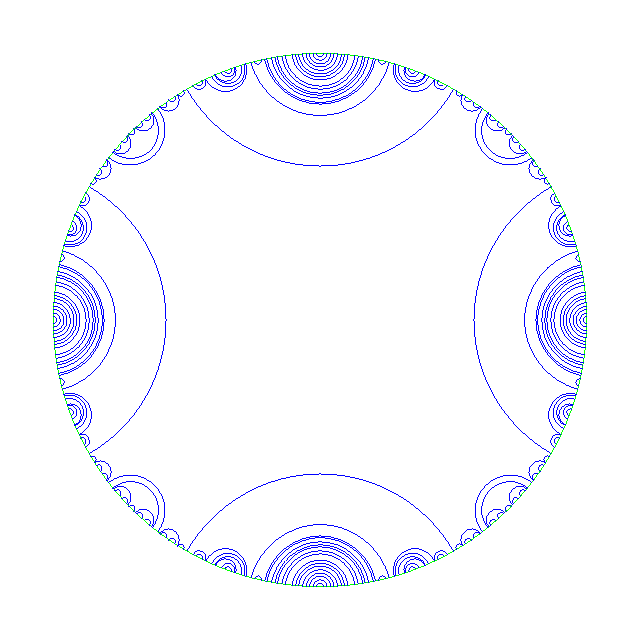
 Invariant laminations were introduced in [41]; they play a major role in polynomial dynamics. The preceding papers [8, 9] of this series contain an overview, based on [41] and [6]. Here we follow [8] and [9] (see Section 2 of [8] for a detailed discussion).
If a monic polynomial has a locally connected Julia set , then is topologically conjugate to a suitable quotient of the -tupling map (where if is viewed as the unit circle in and as if is identified with ). The quotient is with respect to an equivalence relation ; the leaves of the corresponding lamination are by definition the edges of the convex hulls of all -classes.
A chord of with endpoints is denoted by ; it is critical if while . A lamination is normally denoted by while the union of all its leaves and by . For , denote by and call the elements of vertices of . Call a gap of a lamination if it is the closure of a component of . A gap is said to be critical if its image is not a gap or the degree of is greater than 1. A critical set is a critical leaf or a critical gap. If is a leaf or a gap of , then coincides with the convex hull of . A gap is called infinite (finite) if and only if is infinite (finite).
Let be a lamination. The equivalence relation induced by is defined by declaring that if and only if there exists a finite concatenation of leaves of joining to . A lamination is called a q-lamination if the convex hulls of -classes are precisely finite gaps or leaves of . Two distinct chords are called (-)siblings if they have the same -image.
3.1 Symmetric laminations Let be the rotation of (or of ) by around its center . Also, given a map we call preperiodic of preperiod or -preperiodic if is -periodic while is not periodic.
A -invariant lamination is called a symmetric (cubic) lamination if implies .
Given a non-diameter chord in , define the arc as the shortest arc of joining the endpoints of . If and are chords such that , then we say that is under . Define the length of as the length of divided by in the case when is not a diameter; if is a diameter, set . Given a symmetric lamination , call a leaf a major of if there are no leaves of closer in length to than .
Let be a piecewise linear function with slope defined as if and as if . Then . Simple analysis of the dynamics of shows that for any leaf an eventual image of has length , or length , or length which is between and .
Suppose that . Then there exists a sibling chord of such that the strip of between and has two circle arcs on its boundary, each at most long. We also consider chords and as well as the -strip between them. The union , denoted , is called the short strips set of .
If a major of a symmetric lamination is critical, there is a unique point that is not an endpoint of with the same -image as . This point is called a comajor (of ). If is not critical, then a leaf (similar to from the above) and leaves and are also majors of . We set in this case and call this set the short strips set of . Let us stress again that is formed by two strips and that . The third sibling of that is disjoint from , is of length at most . It is called a comajor (of ). Similarly we define a cocritical set of a critical set as the gap, or the leaf, or the point disjoint from but with the same image as .
Because of the symmetry, comajors, majors, etc., come in pairs. A pair of comajors of a symmetric lamination is called a symmetric comajor pair. It is degenerate if its elements are points and non-degenerate otherwise. For a symmetric lamination we often assume that one of its majors is marked; we denote this major by and the corresponding comajor by . Observe that if and are symmetric laminations such that (e.g., if ) then the comajors of are located under the comajors of .
Let be a leaf of a symmetric lamination with . If is the least such that , then the leaf non-strictly separates (in ) either from or from . Thus, either equals one of the leaves or it is closer to in length than . In particular, forward images of majors/comajors of never enter the open circle arcs on the boundary of the set .
Lemma 3.3 motivates the next definition.
If a symmetric pair is either degenerate or satisfies the following conditions:
no two iterated forward images of cross, and
no forward image of crosses the interior of ,
then is said to be a legal pair.
A legal pair is the comajor pair of the symmetric lamination . A symmetric pair is a comajor pair if and only if it is legal.
A symmetric lamination with an infinite gap such that the map on it is of degree greater than 1 is called a Fatou lamination.
A symmetric lamination is Fatou if and only if it has a preperiodic comajor of preperiod 1.
Suppose that is a symmetric q-lamination with two finite critical gaps each of which is preperiodic of preperiod at least two. Then is called a symmetric Misiurewicz lamination. A symmetric Misiurewicz lamination has a well defined pair of comajors. Suppose that the critical -classes are gaps and with at least vertices each. Then there are two cocritical gaps and of such that and . One edge of and one edge of are the comajors of . Two majors of are edges of that are siblings of the comajor edge of ; two other majors of are edges of that are siblings of the comajor edge of . While other edges of and are not siblings of the comajors, they can generate majors of other laminations that are finite tunings of .
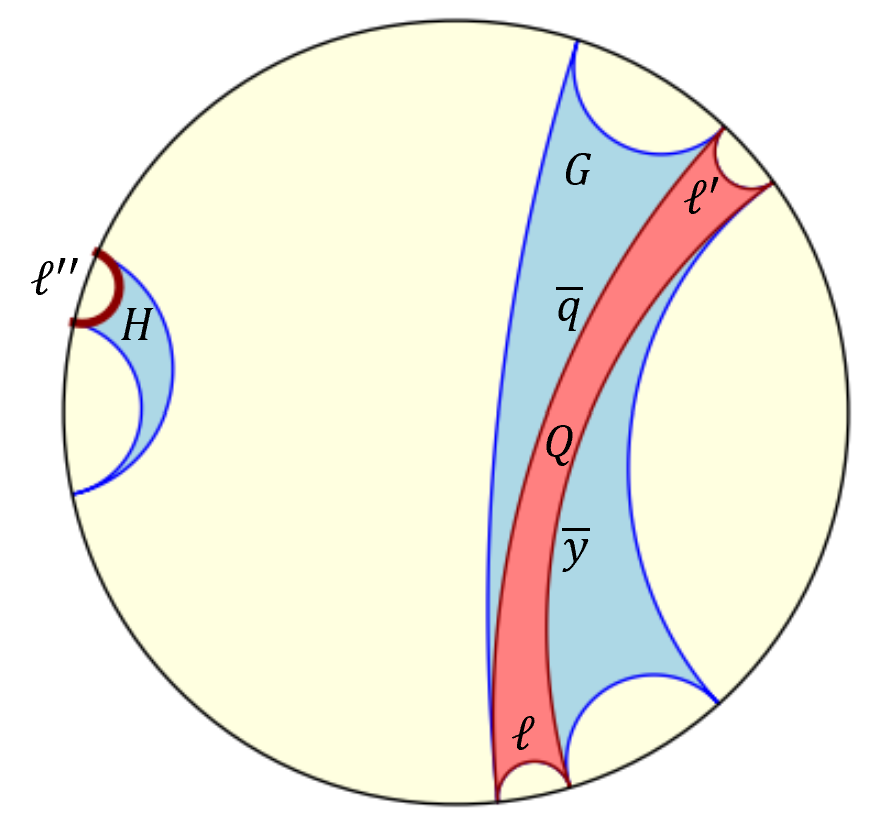
Indeed, suppose that and are two sibling edges of that are not majors. The convex hull of is a 4-gon with two extra edges and not equal to or , see Fig. 2. Construct a new lamination (not a -lamination) by inserting and in , pulling them back along the backward orbit of and then doing the same with and its backward orbit. The majors of are and and their -images. If is a leaf of which is not an edge of and is such that then and are the two comajors of . Repeating this construction for all pairs of sibling edges of but the majors, we see that every edge of the cocritical gap or is a comajor of a certain symmetric lamination which is a tuning of the original symmetric Misiurewicz lamination . Call cocritical sets of Misiurewicz laminations Misiurewicz cocritical sets. By [8, Theorem 3.9], symmetric laminations have no wandering gaps. Therefore, the above is a full description of finite gaps formed by comajors. The cocritical gaps and described above will be called Misiurewicz cocritical gaps; similarly, if a symmetric Misiurewicz q-lamination has critical 4-gons (not 6-gons or higher as was assumed above) we call its comajors Misiurewicz cocritical leaves.
The set of non-degenerate comajors of symmetric laminations is a q-lamination invariant under that induces an equivalence relation on . For any non-degenerate comajor (i.e., a leaf of ) one of the following holds.
It is a two-sided limit leaf in which is not eventually periodic.
It is a preperiodic leaf of with preperiod at least which is either a two-sided limit leaf of (in which case is a Misiurewicz cocritical leaf), or an edge of a finite gap of whose edges are limits of leaves in disjoint from (in which case is a Misiurewicz cocritical gap).
It is a -preperiodic comajor of a Fatou lamination and is disjoint from all other leaves of ; all such comajors are dense in and all 1-preperiodic angles are endpoint of such comajors.
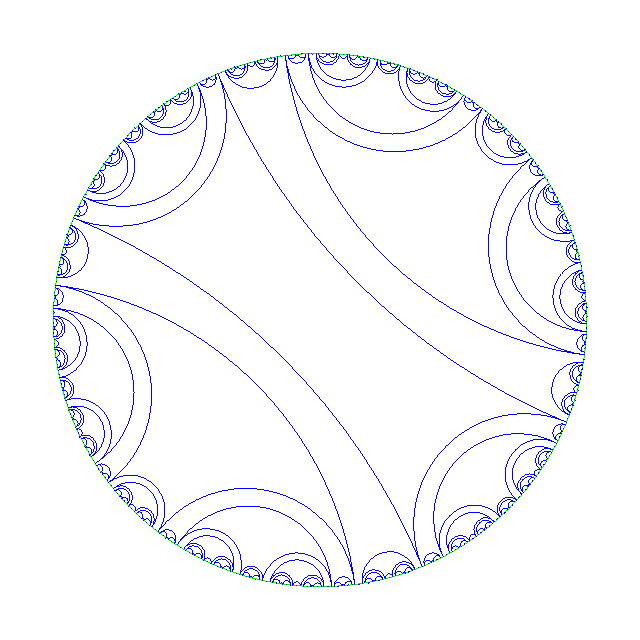
Since comajors are leaves of q-laminations, their endpoints are either both not preperiodic, or both preperiodic with the same preperiod and the same period, or both periodic with the same period. All classes of from Theorem 3.7 are finite. By Theorem 3.7, periodic points of are degenerate comajors.
The q-lamination from Theorem 3.7 is called the Cubic Symmetric Comajor Lamination and is denoted by . It induces an equivalence relation denoted . The -classes corresponding to symmetric Misiurewicz laminations are called Misiurewicz -classes. Denote by the quotient space . Let be the corresponding quotient projection.
Theorem 3.7 verifies the density of hyperbolicity conjecture for .
Let be a symmetric non-empty Fatou lamination. Then one of the following holds.
There is only one cycle of Fatou gaps of . It has even period , and is -symmetric. The periodic majors and of are edges of critical gaps and . Non-periodic majors of are siblings of and and edges of and , respectively. The remaining (i.e., not belonging to a major) -periodic vertices of are such that while .
There are exactly two cycles of Fatou gaps of the same period, interchanged by . Critical gaps , belong to different cycles. The periodic majors and of are edges of and , respectively. Non-periodic majors are siblings of and and edges of and , respectively.
In either case all edges of infinite gaps are eventually mapped to periodic majors. The only periodic orbit of edges of a Fatou gap of is the orbit of a major of and it has the same period as the Fatou gap.
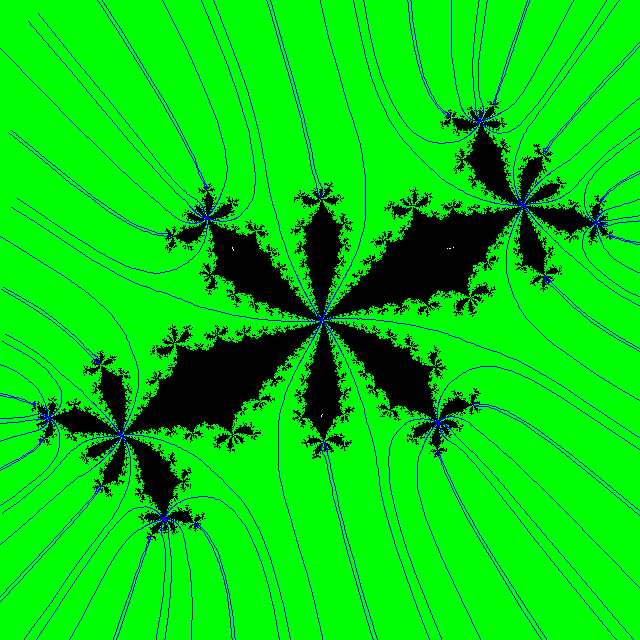
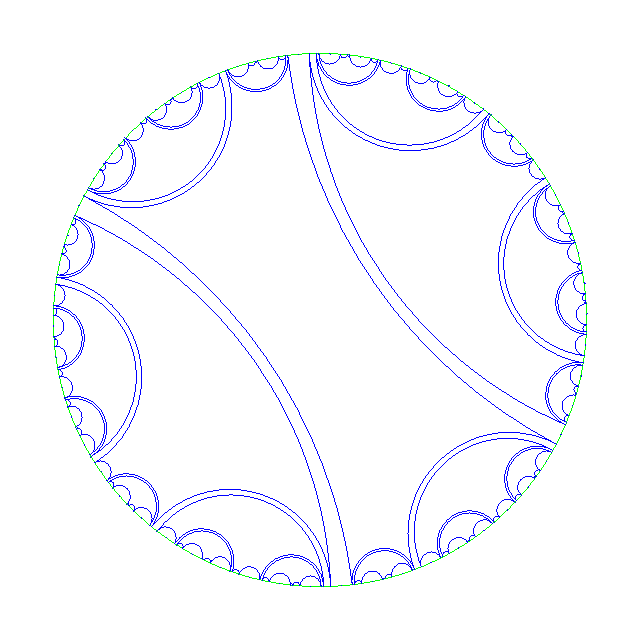
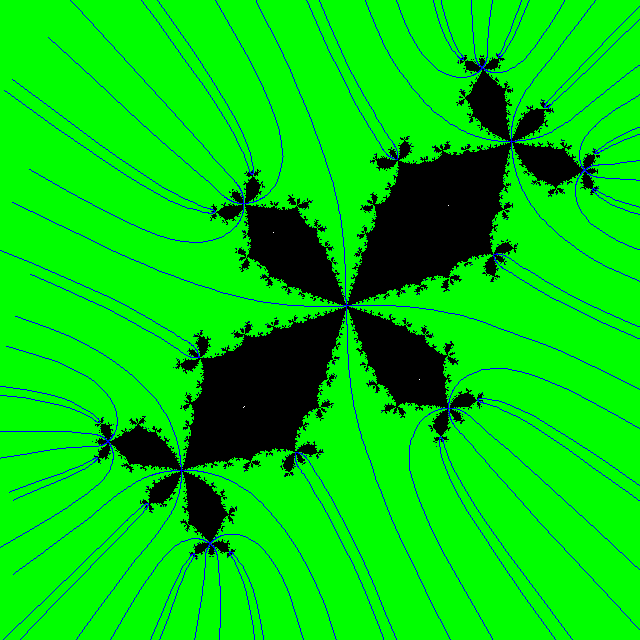
Lemma 3.9 summarizes the results of [8] (compare [8], Lemma 3.8) dealing with symmetric non-empty (i.e., having some non-degenerate leaves) Fatou laminations. Figures 3 and 4 show examples of polynomials of type B and D and the corresponding laminations.
All claims of the lemma except for the last one are immediate; observe that the claims concerning the period of the majors follow from Lemma 3.3. To prove the last claim consider an edge of a critical gap from a cycle of Fatou gaps. It is well-known that any edge of eventually maps to a periodic or a critical edge. Since, evidently, has no critical edges, it suffices to prove that the only periodic edge of is . Indeed, let be a periodic edge of . Then no image of can be a point (since is periodic) or a diameter of (since otherwise itself is a diameter invariant under , hence ). Take the closest approach in length to among the images of . By Lemma 3.3 an eventual image of that is an edge of must coincide with , a contradiction. ∎
The terminology below is adopted from [30, 33], see also [7].
Symmetric Fatou laminations with properties from Lemma 3.9(B) (respectively, Lemma 3.9(D)) are said to be of type B (respectively, of type D).
We will also need an immediate corollary of Lemma 6.1 of [8].
Distinct symmetric Fatou laminations have disjoint comajors.
Next we consider infinite gaps of . One of them plays a special role. Recall that is the center of . Each comajor is of length at most . Hence does not belong to any comajor; it must then lie inside a gap. The main gap is by definition the gap of that contains in its interior.
The gap is infinite, and . Each edge of is a comajor with the same image as the longest edge of a -invariant symmetric finite rotational gap and is associated with the symmetric Fatou lamination formed by , Fatou gaps of degree greater than attached to and “rotating” around , and their pullbacks.
If is finite, then, by Theorem 3.7, it is a Misiurewicz cocritical gap of preperiod at least 2 of a symmetric lamination . This is a contradiction, since then the other cocritical set of contains and intersects the interior of . Thus, is infinite.
Let be an edge of and the marked comajor of a symmetric lamination . Since , then cannot be located under another comajor. By Theorem 3.7, the leaf can only be a 1-preperiodic comajor of a Fatou lamination . Let be the marked critical Fatou gap of with periodic major . If is the limit of leaves of (necessarily from outside of ), then is the limit of leaves so that is located under for any . By Lemma 6.6 of [8], this implies that is the limit of the comajors under which is located, a contradiction. Hence is an edge of a periodic gap and is isolated in . Clearly, so is . Let us remove the grand orbits of and from and consider the resulting family of leaves . It easily follows (essentially, by definition) that is again a symmetric lamination. If is non-empty, then, evidently, it has a comajor such that is under , a contradiction. Thus, is the empty lamination and, so, the grand orbits of and form the entire .
Since must have a finite invariant gap , it follows that consists of , Fatou gaps attached to and “rotating” around , and their iterated pullbacks. Observe that itself must be symmetric under . By Lemma 3.9, the lamination can be of type B or D. By definition, the two periodic majors of are the closest to criticality edges of (in this case it is equivalent to being the longest). There are two comajors of ; just like in the case of symmetric polynomials, either of them can be marked, and so in the lamination is reflected twice. ∎
The following notion will allow us to deal with type B and D laminations in a unified fashion.
Let be a symmetric Fatou lamination and be a critical gap of . If is of type D and the critical gap is of period then set . If is of type B and the critical gap is of period set . Thus, is a self-map of ; it can also be extended linearly over the edges of and, using a barycentric construction, inside . The map is called the first (half-)return map of .
Strictly speaking, depends on the choice of a symmetric lamination and its gap, however, we will not reflect it in writing to lighten the notation. Lemma 3.14 is left to the reader.
Let be a critical gap of a symmetric Fatou lamination . Then maps onto in a 2-to-1 fashion and is semiconjugate to by a monotone map collapsing edges of to points. The fixed point set of is the periodic major of . If is a chord whose endpoints are never mapped to the -fixed point, then the -preimage of spans a chord in that has a unique sibling .
The leaf/point from the last claim of Lemma 3.14 is said to be induced by .
A parabolic quadratic polynomial from the Main Cardioid has a lamination called central; the major of is an edge shared by a finite invariant gap and a critical periodic Fatou gap.
Let be an infinite gap of not containing . Then, for some Fatou lamination , a cocritical Fatou gap of contains , and consists of single points and chords in corresponding to majors of -invariant central laminations. In particular, edges of are -preperiodic while other vertices of have infinite orbits.
Let us consider the ceiling of the gap , that is the unique edge that separates from . In other words, the gap is located under . By Theorem 3.7, the edge is a comajor of a Fatou lamination . Denote by the critical Fatou gap of with periodic major such that . Then all edges of are associated with symmetric laminations that tune . Evidently, is invariant under , the first (half-)return map introduced in Definition 3.13. Recall that is of degree 2 and is modeled by ; the map collapses the edges of and semiconjugates with , as explained above.
Set . Periodic majors of in correspond under to periodic majors of in . It follows that the minor of defines a chord in that is mapped under to the -image of . As is immediate from the definitions, is a comajor corresponding to . Thus, there is a natural correspondence between the quadratic minors and the cubic comajors in . Under this correspondence, pairs with the central gap of the quadratic minor lamination. Hence, the edges of are associated with central quadratic laminations. ∎
4 Connectedness of
Recall that denotes the -th iteration of a map .
The set is invariant under the multiplication by .
We claim that if and then and are conjugate. Indeed, and are conjugate by the map ; hence and are conjugate by . Since is an odd function, we have . Thus, conjugates and . Since while , then and are conjugate. ∎
We now need a construction similar to that for quadratic polynomials; in our description below we follow the exposition from [28]. Take a topological disk around infinity in that contains no critical points of , does not contain , and is such that (in particular, for ). Define Böttcher function on , where the root is taken so that the corresponding functions are tangent to the identity at infinity. The existence of a single valued branch follows from the fact that is simply connected, and that does not belong to . Recall that the Green function is defined as , where is the maximum of and . Then for all . The equipotential is defined as the level set of the Green function; this is a real analytic curve for , possibly singular. Note that conjugates and near infinity.
For , set to be the exterior of the equipotential of passing through (the equipotential has singularities but the exterior of it is a topological disk). Then the required properties of are fulfilled. It is easy to see (from the continuous dependence of the Böttcher coordinate on parameters) that the union of , where runs through the complement of , is open. Standard arguments show that is analytic in both and on .
If , then is always on the boundary of , since the value of the Green function of at the cocritical point coincides with those at . However, the map extends analytically to a neighborhood of . Moreover, is a regular point of this analytic extension in the sense that is a conformal injection in a neighborhood of this point. From now on we will assume that is defined in this neighborhood of .
For a fixed the map is a conformal isomorphism between and the set . This defines initial segments of (dynamical) external rays of , i.e. -preimages of the radial rays of argument in . Evidently, these initial segments of external rays of are orthogonal to all equipotentials . Moreover, as we mentioned above equipotentials can be defined for any . This allows one to give the following definition: a smooth external ray of is a smooth unbounded curve that crosses every equipotential orthogonally and terminates in the Julia set of . All but countably many initial segments of external rays defined above extend as smooth external rays. However countably many initial segments will hit critical points or their eventual preimages (in what follows such points are called (pre)critical or eventually critical) and, therefore, will not extend as smooth external rays.
Let be the Böttcher coordinate of the marked cocritical point in the sense of the analytic continuation mentioned above. Then is well-defined and holomorphic on . Theorem 4.2 is analogous to the corresponding statement for the Mandelbrot set; it proves the first claim of the Main Theorem stated in the Introduction. In what follows we denote the Riemann sphere by .
The symmetric connectedness locus is a full continuum.
Let us show that maps onto . First we prove that as . Set and let
If and , then and hence, . Thus, for (which implies that ) and for any we have .
We conclude that yields
On the other hand,
which yields that
Using the above bounds on , the formula for the sum of the geometric series, and the fact that we see that
that yields the following: as , Thus, the map can be continuously extended to with implying that it can be done holomorphically and that the local degree of at is 1. In particular, is in the interior of the range of .
By the above, , in particular, is compact. Let be the maximum of the continuous function on the compact set . It follows that for all and such that .
We claim that if then . Indeed, otherwise there exists a sequence with . Take such that . Since , then which, by the choice of , implies for all sufficiently large (indeed, for large ). By continuity, ; this shows that the cocritical point of escapes to infinity contradicting the choice of .
Since is not on the boundary of the range of it follows from the above that is a proper holomorphic map from onto . Hence it is a branched covering with a well-defined degree. However, the point has exactly one preimage of degree 1; hence has degree 1 and is actually a conformal isomorphism. ∎
The function gives us an analogue of Böttcher coordinates for the complement of . In particular, we can define external parameter rays (or simply parameter rays) as preimages of radial straight lines under , namely, with . The parameter ray lands at a parameter if . Note that, by definition, the parameter ray consists of the parameters such that the marked cocritical point of belongs to the dynamical external ray of . Also note, that the map is a conformal isomorphism between and tangential to the map at infinity.
5 Hyperbolic components of and their roots Hyperbolic components of polynomial parameter spaces play an important role in complex dynamics. Here we study them for the parameter space of symmetric cubic polynomials.
5.1 Preliminaries We start by recalling basic definitions. Let be a rational function. The multiplier of a periodic point of minimal period under is defined as the derivative of the first return map to , that is, . A periodic point is said to be super-attracting if (which implies that the orbit of contains a critical point), attracting if , and parabolic if is a root of unity (which implies that for some ).
A polynomial (and the parameter ) is hyperbolic/parabolic if both of its finite critical points are attracted to finite attracting/parabolic cycles. To characterize such polynomials we need a lemma.
If is an open topological disk and , then . If is a full continuum and , then .
Set ; then , and is a branched covering. The claim now follows from the Riemann–Hurwitz formula applied to this covering. Take a tight symmetric Jordan neighborhood of and set ; then by the above. Since is the intersection of all such , it follows that . ∎
We can now describe hyperbolic polynomials more explicitly.
A polynomial is hyperbolic if and only if it possesses one of the following:
an invariant symmetric attracting Fatou domain on which is 3-to-1; this happens if and only if , or
a unique symmetric cycle of attracting Fatou domains of period ; there are exactly two mutually symmetric domains in the cycle containing critical points , or
two mutually symmetric attracting cycles of Fatou domains.
Thus, if has an attracting cycle, then is hyperbolic. Also, case (a) is the only case when a hyperbolic polynomial has a unique bounded periodic Fatou domain.
If there exists a Fatou domain on which the map is 3-to-1, then must be symmetric (otherwise, is another Fatou domain on which the map is 3-to-1, which is impossible). By Lemma 5.1, this implies that and is invariant. Since there must exist a unique fixed point in and this point must be attracting, then , being a fixed point, must be attracting. Since , the corresponding hyperbolic component of is the round disk of radius centered at the origin. This corresponds to case (a) and covers so from now on we assume that and hence has distinct critical points and with mutually symmetric orbits.
If (resp., ) is attracted to an attracting cycle, then so is (resp., ) which implies that if has an attracting cycle, then is hyperbolic. We can also assume that there are no 3-to-1 Fatou domains. Now, if has a cycle of attracting Fatou domains then by symmetry is also a cycle of attracting Fatou domains. Suppose that . By the assumption critical domains in contain exactly one critical point; since is symmetric, the critical domains in are mutually symmetric. Moreover, the fact that is symmetric implies that the first iterate that maps either critical domain from to the other one is the same for both critical domains which implies that the period of is . This corresponds to case (b). Otherwise and are distinct cycles of Fatou domains which corresponds to case (d). ∎
Lemma 5.3 is similar to Lemma 5.2 and its proof is left to the reader.
Suppose that a polynomial has a parabolic cycle. Then one of the following holds:
a unique symmetric cycle of parabolic Fatou domains of of period has exactly two mutually symmetric critical domains;
two parabolic cycles of Fatou domains of are mutually symmetric.
For brevity, a Cremer/Siegel point (cycle) of a polynomial will be referred to as a CS-point (cycle). Now we show that for CS-cycles the situation with symmetric polynomials is similar to that in Lemma 5.2. First we state a part of Theorem 4.3 from [4] combined with results from [18] and [23]. Define a rational cut as the union of two external rays with rational arguments that land on the same point called the vertex of the cut. If the vertex is a repelling (parabolic) periodic point, then we call the cut repelling (parabolic).
Let be a polynomial and be CS-cycle. There exists a recurrent critical point of and a point that are not separated by any rational cut of . Two different objects, each of which is a CS-point, a parabolic domain, or an attracting domain, are always separated by a rational cut.
Theorem 5.4 is used in the proof of the following lemma.
Suppose that a polynomial has a CS-cycle . Then one of the following holds:
the only non-repelling cycle of is , and neither of the critical points is separated from by a rational cut;
the only non-repelling cycle of is , it is a symmetric cycle of period ;
there are exactly 2 non-repelling cycles, namely, and .
Assume that is a CS-point. Then, by Theorem 5.4, there is a recurrent critical point not separated from by any rational cut, and the same holds for . This corresponds to case (a) of the lemma.
If is parabolic or attracting then it attracts at least one critical point of and hence, by symmetry, both of them. In this case has no other non-repelling cycles. So, from now on we assume that is repelling.
If has a symmetric CS-cycle of period then, by Theorem 5.4, it has a point not separated from a recurrent critical point, say, , of by a rational cut; hence, is not separated from a recurrent critical point of by a rational cut. This, again by Theorem 5.4, implies that there are no other non-repelling cycles of . This corresponds to case (b) of the lemma.
Finally, let and be distinct mutually symmetric CS-cycles of . By Theorem 5.4, we may assume that has a point not separated from a recurrent critical point, say, of by a rational cut; hence, is not separated from a recurrent critical point of by a rational cut. This implies that there are no other non-repelling cycles of . This corresponds to case (d) of the lemma. ∎
5.2 Hyperbolic components and multipliers Let have a periodic point of period such that . By the implicit function theorem applied to the equation , there is a holomorphic function defined on an open Jordan disk around such that , and is a periodic point of of period . Also, the multiplier is a holomorphic function of . Hence the set of hyperbolic parameters is an open subset of ; a connected component of this set is called a hyperbolic component of . For any the -limit set of the marked critical point is the unique marked attracting cycle ; the period of is the period of . Conjecturally, every connected component of the interior of is hyperbolic.
Every component of the Fatou set of a rational function is eventually periodic. In particular, any bounded Fatou domain of a hyperbolic symmetric cubic polynomial eventually maps into a cycle of Fatou domains that contains an attracting cycle.
Recall that, by Lemma 5.2, the set is a hyperbolic component of .
The set is called the main hyperbolic component of and is denoted .
Corollary 5.8 follows from Lemmas 5.2, 5.3 and 5.5.
A polynomial has one symmetric non-repelling cycle, or two mutually symmetric non-repelling cycles with equal multipliers, or no non-repelling cycles at all.
Let be a hyperbolic component and . Denote by the critical Fatou domains of that correspond to the critical Fatou gaps , respectively, of (we always assume that the marked critical point belongs to ). Let and be the majors of that are edges of ; then by Lemma 3.9, and we always assume that is periodic. Let be the marked comajor (i.e., ) and let be the other comajor of . Similar objects can be defined for any hyperbolic or parabolic parameter yielding such notation as .
Let a hyperbolic component be given. All satisfy the same option , or from Lemma 5.2. According to these three cases, is said to be of type A, B or D, respectively. Also, given a polynomial with parabolic (or attracting) periodic point , let be the minimal number such that fixes dynamical external rays landing on (or the point itself if it is attracting); note that it does not depend on the choice of a particular ray and is called the ray period of . The number is called the ray multiplier (of ) and is denoted . Notice that the period of a parabolic point may be strictly smaller than so that is a multiple of the period.
A similar concept can be defined for a hyperbolic component . Namely, let be defined as . As we show in Theorems 5.9 and 5.10, the function can be extended over . For a parabolic parameter , this extended function may not be equal to . To emphasize that, we use the subscript H in the notation, and call the ray multiplier based on . This difference is not present for parameters , but does show for parameters .
For a type D hyperbolic component of the map can be extended onto so that is a homeomorphism conformal on .
The result essentially follows from Theorem C of [21], however, we need to explain how the terminology of Inou–Kiwi relates to ours. Let be a cubic invariant q-lamination with at least one cycle of Fatou gaps. With , one associates a reduced mapping schema . Instead of giving a general definition of mapping schemata, we give an explicit description of in the case when is symmetric of type D, that is, when has two distinct cycles of Fatou gaps. In this case, can be represented as the graph with two vertices and two (directed) edges that are loops based at both vertices. Every edge of is in general equipped with a positive integer called the degree; in our specific case, the degrees of both loops are equal to 2. Intuitively, the arrows of represent the first return maps to the critical Fatou gaps of . The space in our specific case consists of all pairs of monic centered quadratic polynomials , with connected Julia sets — informally, the two loops of are replaced with and .
By definition, the space consists of all monic cubic polynomials such that
the filled Julia set is connected;
for any (pre)periodic leaf of with endpoints , , the corresponding external rays and land on the same (pre)periodic point of ;
let , be the critical Fatou gaps of ; the corresponding subcontinua and of are polynomial-like filled Julia sets of certain polynomial-like restrictions of , where is the period of and .
Here, one needs to explain in which sense corresponds to , and similarly with and . For each , let and be the endpoints of , and write for the cut formed by the external rays , , and their common landing point. Then corresponding to means that lies on the same side of as relative to , for every . By the Douady–Hubbard straightening theorem, is hybrid equivalent to a unique monic quadratic polynomial near , where , . The Inou–Kiwi straightening map (abbreviated as IK-straightening map) takes to . (The fact that are quadratic yields some simplification: in higher degree cases one needs additional normalization called internal angles assignment in order to make unique).
Theorem C of [21] can now be formulated as follows. Denote by the set of hyperbolic maps contained in (in our specific case, being hyperbolic means both and are hyperbolic). Then , the inverse image of under is an open set, and the restriction of onto this open set is biholomorphic. Now let be a given type D hyperbolic component of ; it lies in some hyperbolic component of the connectedness locus of all monic centered cubic polynomials. All polynomials from have the same lamination, say, . By Theorem C of [21], the restriction of to is a biholomorphic isomorphism between and the product of the interior of the main cardioid with itself. The image of under is then the diagonal in , and the restriction of is a biholomorphic map between and this diagonal (the latter is isomorphic to under the multiplier map). It follows that is a conformal isomorphism. Since the boundary of any hyperbolic component is contained in a real algebraic curve and, as such, is locally connected, then, clearly, it extends to a homeomorphism . Observe that the situation here is similar to the quadratic case [15]. ∎
Let a polynomial have a parabolic or attracting cycle of type B. Then the period of is an even number , and for every . The number does not depend on the point , is denoted , and is called the ray half-multiplier (of ). Note that can be interpreted as the multiplier of the fixed point of the map . As before, the ray half-multiplier depends only on the parameter and is defined as long as is of type B. If , where is of type B, then we write for the restriction of the function to . The ray (half-)multiplier of is defined as either or depending on whether is type D or type B.
Let be a hyperbolic component of of type B. The map can be extended over so that is a homeomorphism which is conformal on while the ray multiplier is a double-covering.
Similarly to Theorem 5.9, Theorem 5.10 also follows from Theorem C of [21]. Let be the hyperbolic component in the full space of monic centered cubic polynomials containing . All polynomials from have the same lamination so that the corresponding reduced mapping schema has two vertices and two directed edges connecting the two vertices in opposite directions; each edge has degree 2. The space consists of pairs of monic centered quadratic polynomials such that the Julia set of is connected. The straightening map of Inou–Kiwi provides a biholomorphic isomorphism between and the principal hyperbolic component in consisting of all such that has an attracting fixed point, and is a Jordan curve. Clearly, symmetric cubic polynomials are mapped to pairs , for which . The corresponding slice of the principal hyperbolic component is biholomorphic to , and the corresponding conformal isomorphism is given by the multiplier of the attracting fixed point of . ∎
Let us now define the center and the root of a hyperbolic component.
Let be a hyperbolic component of type B or D. The center of is the point such that has superattracting cycle(s). The root of is the point such that (if is of type D) or (if is of type B).
Lemma 5.12 justifies the above definition of the roots.
Suppose that is a parabolic point of of ray period . Then there is a major of such that both and land on , for some with . Moreover, the ray (half-)multiplier of equals .
Let be a period parabolic domain attached to , and be the Fatou gap of corresponding to . Replacing with a suitable Fatou gap from the same cycle, we may assume that has a unique periodic major . If is of type D then the only -fixed point in is and the only -fixed points in form the major . Hence and land on . If is of type B then and there are three -fixed points in associated with and two vertices of . Let be points associated with vertices of . We claim that are not parabolic. Suppose that is parabolic. Then by part (B) of Lemma 3.9, which implies that is also parabolic, a contradiction. Hence only can be associated with as desired. Let us now prove that the ray (half-)multiplier of equals 1.
(B) Let be of type B, be parabolic, and be of period ; then , and, by Lemma 3.14, the map fixes the two external rays of landing on . Hence , which implies that .
(D) Similar to (B) (details are left to the reader). ∎
The main component of (for which 0 is attracting) is a round disk of radius . For the Julia set is a Jordan curve and is conjugate to . In other words, the map is neither of type B nor of type D, and neither Theorem 5.9 nor Theorem 5.10 applies. Each polynomial with has a neutral fixed point at of multiplier . If then the corresponding polynomials have multiplier 1 at fixed point . It is easy to see that the lamination associated with has the leaf , which is the horizontal diameter of the unit circle, and two invariant Fatou gaps located, respectively, above and below ; the presence of these invariant gaps completely determines the lamination. In particular, the laminations at these two parameters are different from the empty lamination which corresponds to any polynomial in . We will not consider these points (or any other points) as roots of so that has the center (at the origin) but does not have a root.
6 Parabolic polynomials The following stability property will be used repeatedly. We state it only for symmetric cubic polynomials.
Let be a repelling periodic point of such that an external dynamical ray with rational argument lands on . Let be an angle such that an eventual -image of belongs to the -orbit of and the rays from the (finite) -orbit of are all smooth and do not land on critical points. Then, for sufficiently close to , the dynamical external rays from the -orbit of are smooth, move continuously with , and land on preperiodic or repelling periodic points of close to the landing points of the dynamical external rays of with the same argument.
Recall that the lamination is defined for all such that is locally connected. In particular, if is a hyperbolic component, then for any the lamination exists and is independent of the choice of . Denote it by ; clearly, is a symmetric Fatou lamination.
A polynomial is geometrically finite if all its critical points are preperiodic points or attracted by parabolic or attracting cycles. If, moreover, has no parabolic points, then it is said to be sub-hyperbolic.
Theorem 6.3 based on [20] and additional arguments.
The following holds.
A parabolic symmetric polynomial is accessible from a hyperbolic component of such that .
If is a hyperbolic component and is such that , then and .
(1) Let be the given parabolic polynomial. It is of type B or D. By the main theorem of [20], there exists a path of monic centered cubic polynomials such that is sub-hyperbolic for , and is topologically conjugate to on its Julia set. Since is of type B or D, the polynomial is hyperbolic for any and, hence, there exists a hyperbolic component in the space of all monic centered cubic polynomials that contains the path .
We now use the description of given in Theorems 5.9 and 5.10. In both cases (type D or type B), the straightening map ( or , resp.) yields a biholomorphic parametrization of by pairs of monic centered quadratic polynomials. A path in converging to can be represented as , where , and the latter path converges as to some since both multipliers or half-multipliers have the same limit. It follows that the path in represented by also converges to . On the other hand, this new path consists of symmetric cubic polynomials. Thus is accessible from , as desired.
(2) The claim follows from the assumption that and Lemma 5.12. ∎
The following is a combinatorial description of hyperbolic components of .
The map taking a hyperbolic component (other than ) of to the corresponding marked comajor is a bijection between the hyperbolic components of (with the exception of ) and -preperiodic comajors of . Two distinct marked parabolic polynomials must have distinct marked comajors.
Bijection follows from results of A. Poirier [34], which in turn extend earlier work of Bielefeld–Fisher–Hubbard [2]. Namely, injectivity is Theorem 1.1 and surjectivity is Theorem 1.3. More precisely, the map defined in [34] sends to the corresponding critical portrait. On the other hand, there is a bijection between the marked comajors of and symmetric cubic Fatou critical portraits of period .
It remains to prove the last claim. Suppose that two parabolic marked polynomials and are associated with the same marked comajor . By Theorem, 6.3, is the root of a unique hyperbolic domain such that , and, similarly, is the root of a unique hyperbolic domain such that . By the above, . Hence is the root of , and is the same marked polynomial. ∎
We will now study the place of a parabolic parameter in the parameter space. More precisely, given a hyperbolic component we show that . We also consider parameter rays with 1-preperiodic argument , show that they land on a parabolic parameter , and relate and the marked comajor associated with .
We will interchangeably use notation and for any . Recall also that denotes the rotation of or by .
If are two symmetric laminations such that is Fatou then cannot contain a finite periodic gap located inside a Fatou gap of with an edge which is a major of .
Suppose that the gap as described in the lemma exists and is a major of and an edge of . Consider the first (half-)return map (see Definition 3.13) of with respect to . Then is two-to-one. If exists, it is -invariant, which is impossible. Indeed, is two-to-one and semiconjugate to by the map collapsing the edges of to points; by Lemma 3.9 all edges of are preimages of its major. Hence the existence of implies the existence of an invariant leaf or gap of with a -fixed endpoint, which is absurd. ∎
Every parameter ray at a 1-preperiodic angle lands on a parabolic parameter on the boundary of . Moreover, one of the rays lands on a parabolic periodic point of .
We claim that every parameter ray at a 1-preperiodic angle lands on a parabolic parameter , and the dynamical ray lands on a -parabolic point. Indeed, let be in the accumulation set of . Recall that for , the dynamical external ray passes through the cocritical point escaping to infinity under the action of . Thus, the dynamical external ray has a periodic argument and, therefore, is not smooth because an eventual -image of is the argument of an external ray that terminates at the critical point . In particular, is not smooth.
On the other hand, the dynamical external ray of is periodic and lands on a repelling or parabolic periodic point of . Hence lands on a non-periodic point such that . Since , all dynamical external rays of are smooth. If is a repelling point of , then, by Theorem 6.1, the dynamical external ray is smooth and lands on a repelling periodic point for all close to . However, by the previous paragraph, if then is not smooth. This shows that is a parabolic point of .
Since the dynamical ray lands on , the period of divides the -period of . Since the multiplier of with respect to is 1, there are finitely many candidates for an accumulation parameter . Indeed, parabolic parameters , for which there exists an -periodic point of multiplier 1, form an algebraic subset of ; this algebraic set is either finite or the entire plane, the latter option being clearly nonsensical. As the accumulation set of a ray is connected, it consists of exactly one such parabolic parameter. It follows also that one of the dynamical external rays lands on a parabolic point of . ∎
Recall that if is locally connected, then there is a well-defined -invariant lamination .
Let be a degree monic polynomial. For such , define repelling (or -repelling) leaves of as leaves corresponding to pairs of rays landing on the same repelling periodic point of or an iterated preimage thereof. Similarly, we can talk of parabolic (or -parabolic) leaves of .
Repelling leaves and related laminations were used in [10] in the proof of continuity of the constructed there monotone (except for one point) model of the entire cubic connectedness locus.
Suppose that a sequence of monic degree polynomials converges to a polynomial (necessarily monic of degree ) as . Then the following holds.
Let the dynamical external rays of with periodic arguments land on the same point (neither nor the angles depend on ). If the landing points of , , are repelling, then they coincide.
If and all are locally connected, for some lamination , and no critical point of is mapped to a repelling periodic point, then all repelling leaves of belong to .
The lemma follows from Theorem 6.1. ∎
We are going to apply Lemma 6.8 to the situation where is on the boundary of a hyperbolic domain in some parameter space of polynomials and for each .
Suppose that a parameter is such that the rays hit a critical point. Let be a -periodic polygon whose iterated forward -images are disjoint from the critical leaves and . Then all dynamical external rays of arguments that are vertices of land on the same point.
This statement is not new: see [17]; it can also be deduced, e.g., from a more general Theorem 7.1 of [14], which gives a model for the landing pattern of all external rays of (cf. also [13, Theorem 5.4] for a restatement of this result in the language of invariant laminations). For completeness, we give a sketch in our specific situation.
Consider all external rays in the dynamical plane of whose arguments correspond to vertices of . All these rays land, perhaps at different points. Let be the union of these rays with some continuum so that is connected and disjoint from the forward orbits of the critical points of . Denote by the period of . For every , let be the -pullback of that contains the same collection of external rays as and the -pullback of the connecting continuum along the orbit of .
Since is hyperbolic, the sequence converges to a connected set, comprising the original periodic rays and a continuum containing their landing points. However, all points of the limiting continuum must be inside of the Julia set, so this continuum has to be a singleton since the Julia set is totally disconnected. ∎
We can now prove a key theorem describing the limit transition of laminations in our situation.
If is parabolic then the following holds.
If for a hyperbolic component then and .
If is the landing point of a parameter ray and is 1-preperiodic, then is an endpoint of the marked comajor of .
(1) By the main result of [19], there exists a parabolic parameter with (the surgery of [19] is local, hence it can be performed in a symmetric fashion to yield a symmetric polynomial ). This parabolic parameter is the root point of a certain hyperbolic component such that , by Theorem 6.3. Moreover, and have the same marked (co)majors. It remains only to establish that , and the latter follows from Theorem 6.4.
Alternatively, remove all parabolic leaves from to get a new symmetric hyperbolic lamination . By Lemma 6.8, . Hence is a tuning of done in two steps: (I) consistently add to a cycle (in the B case) or two cycles (in the D case) of finite gaps (of the same period as the corresponding cycles of hyperbolic gaps of ) with attached hyperbolic gaps; (II) pull this finite collection of gaps back. Moreover, is obtained similarly. Since by Pommerenke-Levin-Yoccoz inequality the combinatorial rotation number of the inserted cycle(s) of finite gaps in both and cases is the same, .
(2) Let be the closure of the maximal open subset of containing and disjoint from all repelling leaves of . Since there are no fixed return triangles of by Lemma 4.4 of [8], either , or the boundary of consists of a Cantor subset of and countably many pairwise disjoint leaves of . Clearly, . We claim that if then there exists a gap such that all images of inside share an edge with . Indeed, suppose otherwise. Then it follows from [23] that there are repelling cutpoints of such that the convex hulls of the arguments of dynamical external rays of landing on them separate , a contradiction with the definition of . This proves the existence of with the listed properties. Moreover, it follows that the edges of are the periodic leaves of inside .
By Lemma 6.8, the angles are vertices of . By Lemma 6.6, one of the rays (say, ) lands on a parabolic periodic point of . By way of contradiction, suppose that . Set to be the marked major of ; by assumption . Then and we can consider the gap defined in the previous paragraph. Since at least two rays land on each parabolic point of , the dynamical external rays whose arguments are vertices of land on . Thus, the three angles and are vertices of and the dynamical external rays of arguments and land on . Note that the major edge of coincides with the marked major of .
Similar to the construction of the degree two first (half-)return map (see Definition 3.13), define a degree two map semiconjugate to by collapsing edges of to points. Under this semiconjugacy maps to a finite -invariant gap (or leaf) , and the critical leaf projects to a critical leaf in with a -periodic endpoint which is a vertex of but not an endpoint of the Thurston major of (see [41]). Therefore there exists a finite -invariant gap disjoint from . Then the lifting of gives a finite -invariant gap . Note that and have disjoint sets of vertices.
Now consider a point on the parameter ray , where the parameter corresponds to the value of the Green function for at so that converges to as . Then the rays both hit the marked critical point . By Lemma 6.9, the dynamical external rays of whose arguments correspond to the vertices of land on the same repelling periodic point . The point has a well-defined limit as . On the other hand, for every angle corresponding to a vertex of , the ray lands on a repelling periodic point of . By Theorem 6.1 and by Lemma 6.8 this point is close to for small , hence it must coincide with . Thus, is repelling for , and the gap or leaf corresponding to must belong to , a contradiction. ∎
Observe that, by Lemma 6.6, there is a dense set of 1-preperiodic angles such that the corresponding parameter rays land on parabolic parameters in .
Let be the marked comajor of a symmetric Fatou lamination . Then there exists a unique hyperbolic component such that the parameter rays land on the root point and . Moreover, let be a parabolic parameter. Then , and the marked comajor of is located under the marked comajor of .
Consider the marked comajor of a symmetric Fatou lamination . Then and are 1-preperiodic. By Lemma 6.6, the parameter ray lands on a parabolic parameter . The angle is an endpoint of the marked comajor of the lamination , by Theorem 6.10. Since distinct 1-preperiodic comajors are disjoint, . By Theorem 6.3, there exists a hyperbolic component such that is the root of . By Theorem 6.10, the lamination coincides with . By Theorem 6.4, the set is a unique hyperbolic component such that . It follows that lands on , too. The fact that follows from Theorem 6.10.
To prove the last claim of the theorem, let , be a parabolic parameter. Since , the repelling periodic points of polynomials associated with the marked major of converge to a repelling periodic point of of the same period as . Hence all the edges of the gaps of remain edges of . Thus, the critical gaps of are contained in , and, hence, , and the comajors of are located under those of (this yields the claim of the theorem about the marked comajors). The hyperbolic component with the same marked comajor as cannot coincide with , since is not a root point of . Hence, . ∎
Call the parameter rays from Theorem 6.11 characteristic rays of a hyperbolic component . Recall that by an arc we always mean the positively oriented circle arc with endpoints .
The characteristic rays are the only two strictly preperiodic rays that accumulate on a parabolic parameter .
By Theorems 6.3 and 6.11, is the landing point of the parameter rays and where is a 1-preperiodic comajor. Thus, all 1-preperiodic comajors give rise to cuts in the parameter plane. Hence, if a comajor separates from an angle in , then cannot accumulate on . Since, by Theorem 3.7, the 1-preperiodic comajors are dense in and disjoint from all other comajors, it follows that the only way a parameter ray can accumulate on is when is a vertex of an infinite gap with an edge . However, by Theorem 3.15, the fact that is preperiodic implies that is actually 1-preperiodic. Again by Theorem 6.3, this implies that cannot land on , as desired. ∎
Each parabolic parameter is associated to a comajor which is an edge of and, accordingly, to a point of . The parameter rays and land on . For every hyperbolic domain the corresponding marked comajor is associated to the parameter rays and that land on the root of and separate from .
Let be a parabolic parameter. Then is a parabolic point associated to a finite invariant gap whose vertices are the arguments of dynamical external rays of landing on . It follows that there is a unique symmetric lamination associated with which has the gap , Fatou gaps of degree greater than 1 attached to and “rotating” around , and pullbacks of all these gaps (this fully describes ). Let be the marked comajor of associated with the marked cocritical point of ; by Theorem 6.11, the parameter rays and land on . By Theorem 3.12, all parabolic parameters correspond to edges of the main gap of and in the end map to the corresponding points of that belong to the main domain of . The rest of the theorem easily follows. ∎
7 Misiurewicz parameters A number is a Misiurewicz parameter if the -orbits of critical values are strictly preperiodic. If is a Misiurewicz parameter, then is connected (), all -periodic points are repelling (see Theorem 5.4), and is a dendrite (recall that a dendrite is a locally connected continuum that contains no Jordan curves). Recall that a cubic symmetric lamination is called a Misiurewicz lamination if its critical sets are strictly preperiodic. Such laminations and their comajors are discussed in detail right after Lemma 3.6. By Theorem 3.7(2), Misiurewicz cocritical leaves (gaps) are leaves (gaps) of approached from all sides by 1-preperiodic comajors. Since for each polynomial from a critical point is marked, then each Misiurewicz lamination is considered twice, with either cocritical set marked. Finally, recall that the lamination defines a laminational equivalence relation . For brevity by “-class” we will mean an equivalence class of .
Let be a cubic symmetric polynomial with a dendritic Julia set, and be the marked critical set of . If converge to as , then the arguments of the external rays of hitting the marked critical point converge to vertices of .
Every leaf of that is not an edge of a gap is approximated by (pre)periodic leaves from both sides, and every edge of a gap in is approximated by preperiodic leaves from outside of . Choose a neighborhood of in whose boundary is formed by (pre)periodic leaves close to the edges of , and appropriate circle arcs. By Theorem 6.1, there is a neighborhood of in such that for , the leaves forming the boundary of in are associated with cuts formed by the dynamical external rays of (it does not matter whether is connected or not). The part of the dynamical plane of bounded by all these cuts contains the point . This implies the desired. ∎
The following theorem is a special case of [26, Theorem 1] but we give a proof for completeness, and also since our special case is much simpler than the general one.
Let be a Misiurewicz lamination. Parameter rays whose arguments are vertices of the marked cocritical set of land on a Misiurewicz parameter such that .
Let be a -preperiodic angle with . Choose in the accumulation set of . Then the periodic dynamical external ray lands on a periodic point . By Lemma 6.12, the point is repelling. For a parameter , consider the union of the rays from the forward orbit of the closure of ; it consists of finitely many rays and their landing points. By Lemma 7.1, there are no critical points among their landing points provided that is close to .
By Theorem 6.1, for some neighborhood of in , the set depends continuously on , consists only of smooth rays and their landing points, and contains no critical points of . In particular, lands on the cocritical point . Thus, is a symmetric Misiurewicz polynomial, and is a symmetric Misiurewicz lamination. Since there are countably many symmetric Misiurewicz polynomials, and the accumulation set of is either a non-degenerate continuum (hence uncountable) or a point, it follows that lands on and that is a vertex of a cocritical set of .
By Theorem 3.7, all preperiodic angles of preperiod are partitioned into vertex sets of various Misiurewicz cocritical sets. Thus, for a preperiod angle there exists a unique symmetric lamination such that is a vertex of a cocritical set of . Taking into account the fact that each polynomial is counted in twice (depending on the choice of the marked critical point), and choosing marked cocritical sets accordingly, we see that if is a Misiurewicz lamination whose marked cocritical set has vertices , , , then the parameter rays land on a Misiurewicz parameter such that . ∎
8 The Structure of
Recall that is the quotient space of under and is the corresponding quotient projection (see Definition 3.8). Given a continuum , define the topological hull of as the complement to the unbounded complementary component of . Recall also that a monotone map is a map whose point-preimages (fibers) are connected. Theorem 8.4 completes the proof of the Main Theorem.
However first we introduce tools from continuum theory developed in [3] (for basic continuum theory facts see, e.g., [35]) and applied in [3] to the problem of modeling connected polynomial Julia sets. The tools apply to all planar continua.
Let be a continuum. Then an onto map is said to be a finest (monotone) map (onto a locally connected continuum) if for any other monotone map onto a locally connected continuum there exists a monotone map such that . Observe, that in this situation the map is automatically monotone because for we have . It is easy to see that all sets are homeomorphic and all finest maps are the same up to a homeomorphism. Thus from now on we may talk of the finest model of and the finest map of onto .
A planar continuum is said to be unshielded if it coincides with the boundary of its topological hull. Thus, unshielded continua are the boundaries of full planar continua.
Let be an unshielded continuum. Then there exist the finest map and the finest model of . Moreover, can be extended to a map which maps to , in collapses only those complementary domains to whose boundaries are collapsed by , and is a homeomorphism elsewhere in .
It may happen that the finest model is a point (e.g., this is so if the continuum is indecomposable, i.e. cannot be represented as the union of two non-trivial subcontinua). In [3] we establish useful sufficient conditions for this not to be the case, then apply Theorem 8.1 to a polynomial with connected Julia set, and explicitly construct the finest models (see Theorem 8.3 below). Moreover, in [3, Theorem 2] we show that for a connected polynomial Julia set the model is dynamical, i.e. admitting a self-mapping to which is semiconjugate. The self-mapping in question is actually a topological polynomial. This gives an alternative proof of results of [25] and extends them onto all connected polynomial Julia sets. Denote by the impression of the Riemann ray to an unshielded continuum which by definition is the same as the impression of the corresponding prime end (abusing the terminology we will call them impressions of angles ).
Let be an unshielded planar continuum. Declare two points equivalent if they belong to a finite connected union of impressions of angles, and denote this equivalence relation on by . Then consider the intersection of all closed equivalence relations on that contain . Declare two angles equivalent if their impressions are contained in one -class, and denote this equivalence relation on by .
Definition 8.2 offers a constructive version of Theorem 8.1. Moreover, it also suggests a laminational interpretation of the finest model of (the second part of Theorem 8.3 is not explicitly proven in [3] but immediately follows and can be established repeating verbatim a part of the proof of [3, Theorem 2]).
The quotient map is the finest map of the continuum . The equivalence relation is laminational, and the finest model of is homeomorphic to .
We can now prove Theorem 8.4.
There is a monotone continuous surjective map ; if is locally connected, is a homeomorphism.
Set and . By Theorem 8.3, the spaces and are homeomorphic. Thus, it suffices to show that equivalence relations and on coincide. By Theorem 3.7 and the results in Sections 6 and 7, if is a -class whose convex hull does not intersect an infinite gap of , then is in fact a -class. It remains to consider -classes whose convex hulls intersect infinite gaps of . In what follows we use notation and terminology from right before Theorem 3.15. In particular, recall that is the center of .
Let be a -class such that intersects , where is an infinite gap of . If , then, by Theorems 3.7 and 3.15, there is an associated with Fatou lamination with critical Fatou gap and the (half-)return map semiconjugate to by a map collapsing all edges of . We have , and the -images of the edges of are the majors of laminations from the Main Cardioid of .
Let be the edge of separating the rest of from . By the properties of the Main Cardioid, an infinite gap of is attached to at any edge of while the points of that are not endpoints of edges of are -classes. By Theorem 3.7, may be an edge of another infinite gap of or it may be non-isolated in .
By Theorem 6.4, there is a unique hyperbolic component with . By Theorem 6.11, a dense subset of consists of parabolic parameters with two parameter rays corresponding to the endpoints of an edge of landing on . Properties of impressions and the fact that is a Jordan curve imply that for all edges of other than the corresponding -class and -class coincide.
The situation with is different and has three cases. Firstly, if is an edge of another infinite gap of not containing , then the above arguments show that the -class associated with consists only of the endpoints of . Secondly, may be the limit of other edges of converging to from outside of . Let be the parameter cut corresponding to . By Theorem 3.7, is approximated by 1-preperiodic parabolic cuts separating from impressions of other parameter rays in the complementary component of not containing ; thus, in this case, too, the -class and the corresponding -class coincide.
The remaining case is when is the shared edge of and the gap of corresponding to . Recall that is the circle of radius centered at the origin. For , the multiplier at the neutral point is . Hence there is a dense in set of parabolic parameters associated to the comajors like above. The above arguments show that for all edges of and for all points of that are not endpoints of an edge of the same conclusion holds: the -classes and the -classes are the same. ∎
From now on, we will always denote the modeling projection from Theorem 8.4 by .
Let be a hyperbolic component associated with a comajor . Then the parameter rays and land on the root of . Denote by the component of that does not contain and will call this set the wake generated by .
The next lemma describes wakes in a more dynamical fashion.
Let be a comajor corresponding to a major .
If , then the external rays and are smooth and land at the same repelling periodic point.
If and are smooth and land at the same repelling periodic point, then .
(1) The argument given below follows [30]. Set , and let be the period of and . The claim holds for the interior of the corresponding hyperbolic domain . By the properties of , parabolic parameters on the boundary of , and hence the entire , are separated from by the parameter rays and that land on the root of . Thus, , and, by Theorem 6.11, for all parameters the dynamical external rays and land on the same repelling periodic point.
We claim that the rays and land for all . Indeed, by the properties of comajors the circle arc contains no images of or . Hence points from the orbits of and cannot be endpoints of critical chords with the other endpoint in . However, these are precisely the critical chords defining the critical cuts for polynomials . It follows that for all the rays and remain smooth (never pass through a cut) and land as claimed.
The landing point of is repelling except for finitely many values of , for which it may become parabolic; the multiplier of this parabolic point must be a -th root of unity. By the maximum modulus principle, such values of are impossible. It follows that always lands on a repelling point, for , and the same holds for . Since the two landing points coincide in , they also coincide everywhere in , by Theorem 6.1.
(2) Suppose that and are smooth and land at the same repelling periodic point. By Theorem 6.1, this property is stable under small perturbations of . In particular, if the Julia set of is connected, then we may replace with a postcritically finite value with the same property. Also, if is disconnected, then, upon a slight perturbation of , one may assume that lies on a rational ray. Let be the landing point of this ray, and replace with a nearby postcritically finite parameter . Thus, in any case, it is safe to assume that is postcritically finite, in particular, is locally connected, and the corresponding lamination determines the topological dynamics of on . All periodic leaves of are repelling.
By the assumption, . Let be the strip formed by and its sibling chord so that is a short strips set. Some major of must be contained in ; it follows that a comajor of is under . Either this is the marked comajor of , in which case , or the symmetric one, in which case . ∎
Recall that, by Theorem 3.7(3) (i.e., by Theorem 4.15 of [9]), the 1-preperiodic comajors are dense in . Using this, we will now relate the dynamics of certain symmetric cubic polynomials with their location in the parameter space. To do this, we will need the original results of Kiwi [25] that we have already mentioned in the beginning of this section. As far as we know, these were the first results where connected but not necessarily locally connected Julia sets of certain polynomials were modeled. The polynomials in question are polynomials with connected Julia set and all cycles repelling. However, when stating Kiwi’s theorem, we use the approach of [3] described in the beginning of this section.
Let be a complex polynomial with connected Julia set and all cycles repelling. Then is a -invariant laminational equivalence relation defining a q-lamination . Moreover, is monotonically semiconjugate to a topological polynomial , the topological Julia set is a dendrite, and the semiconjugacy between and is one-to-one on all (pre)periodic points of . If is locally connected, is a homeomorphism.
Let be a symmetric polynomial with connected Julia set and all cycles repelling. Theorem 8.7 allows one to define, for such , its q-lamination and, therefore, the associated marked cocritical set . Let us show that then determines the fiber of the modeling projection from Theorem 8.4 that contains . To this end, we need a well-known fact concerning the dynamics of dendritic topological Julia sets defined by a laminational equivalence relation . Still, for the sake of completeness we sketch its proof.
Let be a -invariant laminational equivalence relation such that is a dendrite. Suppose that is a periodic chord whose forward -orbit consists of pairwise unlinked chords that do not cross edges of critical sets of . Then .
Consider preimages of critical gaps or leaves of ; choose only those preimages that are themselves gaps of leaves of . Take the closure of their union. By the assumptions made, there is a unique component of the complement to this union that contains in its closure. The set of all classes of points from corresponds to a non-degenerate continuum whose orbit, by the assumption, has no iterated images that contain critical points of as their cutpoints. On the other hand, by Theorem C of [5], the continuum is non-wandering and has two distinct iterated images that intersect. The union of the appropriate iterated images of will then yield connected -periodic subset of whose closure contains no critical cutpoints. This implies that there are periodic attracting points of in , which contradicts the expanding properties of . ∎
We can now describe some fibers, i.e., point preimages, of .
If all cycles of are repelling, then the -fiber of contains . Moreover, for any in the same fiber, and therefore . If, in addition, is finitely renormalizable, then the fiber is .
By Theorem 6.13, we may assume that is not a 1-preperiodic comajor. Suppose now that is a finite gap. Then, by Theorem 3.7(3), all edges of are approximated from outside of arbitrarily well by 1-preperiodic comajors that give rise to the associated wakes in the parameter space. Let us consider the edge of that separates the interior of from the center of the circle. Choose a 1-preperiodic comajor close to that also separates from the center of the circle; it corresponds to a periodic major , and, by the properties of majors, the iterated -images of never enter a critical strip defined by or its symmetric counterpart. Thus, satisfies the assumptions of Lemma 8.8. By Lemma 8.8, this implies that the endpoints of are -equivalent and, hence, are associated with a repelling cut of . Therefore, by Lemma 8.6, the parameter of is located in the wake for any with the listed properties.
On the other hand, let be another edge of . We can approximate it (again by Theorem 3.7(3)) by 1-preperiodic comajors, necessarily from the outside of . These define wakes as before, yet this time the corresponding periodic leaves will not coexist with the critical sets of . Hence, cannot belong to those wakes, which implies that it belongs to their complements in the plane.
By definition, the intersection of the wakes (described in the first paragraph of the proof), the complements of wakes (described in the second paragraph of the proof), and is the fiber of the modeling map from Theorem 8.4; this completes the proof of the first claim in the case when is a gap. If is a leaf, a similar (almost verbatim) argument implies the same conclusion. Observe that in this case Theorem 3.7 implies that is approximated by 1-preperiodic comajors from both sides.
The case when is a singleton is a bit different. Recall, that is a dendrite. Denote by the point in the topological Julia set that corresponds to the convex hull of a -class. By [8, Lemma 3.3], there is a well defined invariant central (i.e. containing the center of the circle) gap (or leaf) of . Let . Connect and with an arc and consider dynamics of points of that are located close to . Let be a point close to . Denote by the component of that contains . Then by Lemma 3.8 (the so-called Short Strips Lemma) of [8] translated into the language of dynamics on we see that the forward orbit of either never enters , or, if it does, the first time it enters is in again. In the former case it follows from the definitions that the edge of that separates the rest of from (i.e., the edge of that “faces” ) is a comajor. By Theorem 3.7(3) this implies that there are 1-preperiodic comajors very close to and the arguments from the beginning of the proof apply in this case, too.
Hence we may assume that orbits of all points close to always eventually enter their sets . However there are (pre)periodic points in arbitrarily close to , and these cannot keep getting mapped to points of closer and closer to . Thus, there are comajors associated to points of arbitrarily close to which implies the desired.
By the above, for every polynomial in the fiber of , the associated lamination has as a marked comajor. It follows that as critically marked laminations, cf. Corollary 3.11. To prove the last claim of the lemma, observe that in the case of finitely renormalizable symmetric polynomials the claim follows from [KvS06, Theorem 1.2] stating, in a special case, that, if is at most finitely many times renormalizable, and both and have all cycles repelling, then , up to affine conjugacy. ∎
To conclude we would like to say that we expect the following claims to hold for the fibers of :
On the union of the boundaries of all hyperbolic components, is injective.
Every nontrivial fiber contains a polynomial whose Julia set has positive area and supports an invariant measurable line field; there is a -stable component inside the fiber consisting of such polynomials.
However, we do not prove these claims here.
References