Research Contribution DOI:10.56994/ARMJ.011.004.008
Received: 02 Jun 2025; Accepted: 07 Jan 2026


Discrete Painlevé equations from pencils of quadrics in \(\mathbb P^3\) with branching generators

Jaume AlonsoInstitut für Mathematik, MA 7-1
Technische Universität Berlin,
Str. des 17. Juni, 10623 Berlin, Germany
email:alonso@math.tu-berlin.de ×
, Yuri B. Suris Institut für Mathematik, MA 7-1
Technische Universität Berlin,
Str. des 17. Juni, 10623 Berlin, Germany
email:suris@math.tu-berlin.de ×
Abstact.
In this paper we extend the novel approach to discrete Painlevé equations initiated in our previous work [2]. A classification scheme for discrete Painlevé equations proposed by Sakai interprets them as birational isomorphisms between generalized Halphen surfaces (surfaces obtained from 1×1 by blowing up at eight points). Sakai’s classification is thus based on the classification of generalized Halphen surfaces. In our scheme, the family of generalized Halphen surfaces is replaced by a pencil of quadrics in 3. A discrete Painlevé equation is viewed as an autonomous transformation of 3 that preserves the pencil and maps each quadric of the pencil to a different one. Thus, our scheme is based on the classification of pencils of quadrics in 3. Compared to our previous work, here we consider a technically more demanding case where the characteristic polynomial Δ(λ) of the pencil of quadrics is not a complete square. As a consequence, traversing the pencil via a 3D Painlevé map corresponds to a translation on the universal cover of the Riemann surface of Δ(λ), rather than to a Möbius transformation of the pencil parameter λ as in [2].

1 Introduction

This paper is the second contribution to our study devoted to a novel interpretation of discrete Painlevé equations, which builds up on [2]. Discrete Painlevé equations belong to the most intriguing objects in the theory of discrete integrable systems. After some examples sporadically appeared in various applications, their systematic study started when Grammaticos, Ramani and Papageorgiou proposed the notion of “singularity confinement” as an integrability detector, and found the first examples of second order nonlinear non-autonomous difference equations with this property, which they denoted as discrete Painlevé equations [9, 16]. The activity of their group was summarized in [8]. A general classification scheme of discrete Painlevé equations was proposed by Sakai [18] and it is given a detailed exposition in the review paper by Kajiwara, Noumi and Yamada [11]. In the framework of Sakai’s scheme, discrete Painlevé equations are birational maps between generalized Halphen surfaces X. The latter can be realized as 1×1 blown up at eight points. A monographic exposition of discrete Painlevé equations is given by Joshi [10].

Let us summarize the main ingredients and features of our alternative approach to discrete Painlevé equations, initiated in [2].

  • A pencil of quadrics {Qλ} in 3 containing non-degenarate quadrics. Such pencils can be classified modulo projective transformations of 3, and they come in thirteen classes. The class of the pencil can be identified by the type of its base curve Q0Q. This is a spatial curve of degree 4, whose type can vary from a generic one (irreducible smooth curve for a pencil of type (i)), through irreducible curves with a node (type (ii)) or with a cusp (type (iii)), to various types of reducible curves (from two non-coplanar conics intersecting at two points, type (iv), to a pair of intersecting double lines, type (xiii)).

  • The second pencil of quadrics {Pμ} having one quadric in common with {Qλ}, say P=Q. The base curves of both pencils intersect at eight points Si, i=1,,8.

  • Given two pencils of quadrics, one can define a three-dimensional analog of a QRT map F=i1i2, where the 3D QRT involutions i1, i2 act along two families of generators of Qλ, see [1]. Each involution puts into correspondence two intersection points of a generator with the quadric Pμ. By definition, such an involution, and therefore the 3D QRT map F=i1i2, leaves each quadric of two pencils invariant, and thus possesses two rational integrals of motion λ=Q0/Q and μ=P0/P.

  • A Painlevé deformation map is the device which allows us to travel across the pencil {Qλ}. More precisely, such a map L on 3 preserves the pencil, but not fiber-wise. Rather, it sends each quadric Qλ to a different quadric Qλ^. Moreover, L preserves the base curve of the pencil {Qλ}. In the cases considered in [2], the base curve is reducible and contains straight lines. In these cases, L does not necessarily fix these straight lines point-wise. In the cases considered in the present paper, L fixes the base curve Q0Q pointwise (in particular, it fixes all eight points Si).

  • A 3D Painlevé map is obtained by composition F~=Li1Li2, provided it possesses the singularity confinement property. It is to be stressed that the pencil {Qλ} continues to play a fundamental role in the dynamics of F~: the maps Li1, Li2 preserve the pencil and map each quadric Qλ to Qλ^. We do not have a straightforward description of the dynamical role of the pencil {Pμ}, but anticipate its relation to the isomonodromic description of the discrete Painlevé equations.

One can say that in our approach the role of a family of generalized Halphen surfaces is played by the quadrics of the pencil {Qλ} with eight distinguished points on the base curve of the pencil. The base curve itself plays the role of the unique anti-canonical divisor. Let us stress several features of our construction which are in a sharp contrast to the Sakai scheme.

  • Neither the exceptional divisor nor the eight distinguished points evolve under the map F~. Their discrete time evolution is apparent and is due to their representation in the so-called pencil-adapted coordinates. These are coordinates (x,y,λ)1×1×1 establishing an isomorphism between each quadric Qλ of the pencil and 1×1. The pencil-adapted coordinates of a point on the base curve do depend on λ, so traversing the pencil λλ^ under F~ induces an apparent discrete time evolution of the base curve and of the eight distinguished points.

  • The shift parameter δ of discrete Painlevé equations (or its exponent q=eδ for the q-difference equations among them) is not an intrinsic characteristic of the configuration of eight distinguished points, but is a free parameter of the construction.

One can say that our approach is a realization of the old-style idea of discrete Painlevé equations being non-autonomous versions (or modifications) of the QRT maps. This idea was instrumental in the discovery and early classification attempts of discrete Painlevé equations, summarized in [8]. A more geometric version of this procedure was proposed in the framework of the Sakai’s scheme by Carstea, Dzhamay and Takenawa [5]. In their scheme, the de-autonomization of a given QRT map depends on the choice of one biquadratic curve of the pencil. In our approach, the choice of the base curve and eight distinguished point on it determines uniquely all the ingredients of the construction, starting with the two pencils of quadrics.

The structure of the paper is as follows. In Section 2, we describe the construction scheme of discrete Painlevé equations applicable to the present case and stress its distinctions from the previous paper [2]. The main distinction is that here we consider the pencils whose characteristic polynomial Δ(λ) is not a complete square. As a consequence, the 3D QRT involutions i1, i2 and the 3D QRT map F=i1i2 are no more birational maps of 3. Rather, these maps become birational maps on 𝒳, a branched double covering of 3, whose ramification locus is the union of the singular quadrics Qλi, where λi are the branch points of the Riemann surface of Δ(λ).

In Section 3, we formulate a general recipe for the construction of the Painlevé deformation map L, responsible to the evolution λλ^ across the pencil of quadrics {Qλ}. While in the first part [2] we had λ^=σ(λ), where σ:11 is a Möbius automorphism fixing the set Sing(Q):={λ1:Qλisdegenerate}, in the present paper the natural definition becomes λ^=λ(ν^), where λ=λ(ν) is the holomorphic uniformization map for the Riemann surface , and ν^=ν+2δ is the translation on the universal cover . The recipe turns out to be applicable to all types of the pencil {Qλ} except for the generic type (i). The latter leads to the elliptic Painlevé equation, which will be treated in a separate publication.

In Section 4, we show that the so constructed L ensures the fundamental singularity confinement property for our 3D Painlevé maps.

There follow five Sections 59 containing a detailed elaboration of our scheme for all relevant types of the pencils except for the type (i). We recover, within our novel framework, all discrete Painlevé equations except for the elliptic one, which is left for a separate publication.

2 General scheme

We now describe the construction scheme of discrete Painlevé equations applicable to the present case and stress its distinctions from the previous paper [2]. The first steps are the same as there:

  • Start with a pencil {Cμ} of biquadratic curves in 1×1 and the corresponding QRT map. Let s1,,s81×1 be the base points of this pencil. Lift {Cμ} to a pencil of quadrics {Pμ} in 3 using the Segre embedding of 1×1 to 3. The base curve of this pencil passes through the lifts S1,,S8 of the base points s1,,s8.

  • Choose one distinguished biquadratic curve C of the pencil, along with its lift to a quadric P.

  • Based on these data, construct the pencil of quadrics {Qλ=Q0λQ} in 3 spanned by Q0={X1X2X3X4=0} and Q:=P. Recall that Q0 is nothing but the image of 1×1 by the Segre embedding. The base curve of the pencil {Qλ} is, by definition, the curve Q0Q, which is the image of C under the Segre embedding. The intersection of this curve with the base curve of the pencil {Pμ} consists exactly of the points S1,,S8.

The characteristic polynomial of the pencil {Qλ} is

Δ(λ)=det(Mλ)=det(M0λM), (1)

where M0,MSym4×4() are symmetric matrices of the quadratic forms Q0,Q. In the present paper, we are dealing with the cases where this polynomial is not a complete square. According to the projective classification of pencils of quadrics, discussed in [2], these are the following six cases:

  • (i)

    Pencil of quadrics through a non-singular spatial quartic curve.
    Segre symbol [1,1,1,1]; Δ(λ)=(λλ1)(λλ2)(λλ3)(λλ4).

  • (ii)

    Pencil of quadrics through a nodal spatial quartic curve.
    Segre symbol [2,1,1]; Δ(λ)=(λλ1)2(λλ2)(λλ3).

  • (iii)

    Pencil of quadrics through a cuspidal spatial quartic curve.
    Segre symbol [3,1]; Δ(λ)=(λλ1)3(λλ2).

  • (iv)

    Pencil of quadrics through two non-coplanar conics sharing two points.
    Segre symbol [(1,1),1,1]; Δ(λ)=(λλ1)2(λλ2)(λλ3).

  • (v)

    Pencil of quadrics through two non-coplanar conics touching at a point.
    Segre symbol [(2,1),1]; Δ(λ)=(λλ1)3(λλ2).

  • (vi)

    Pencil of quadrics tangent along a non-degenerate conic.
    Segre symbol [(1,1,1),1]; Δ(λ)=(λλ1)3(λλ2).

As discussed in [2], for XQλ, the generators 1(X) and 2(X) are rational functions of X and of Δ(λ). The dependence on λ can be expressed as a holomorphic dependence on the point of the Riemann surface of Δ(λ). This Riemann surface is a double cover of ^ branched at two or at four points. By the uniformization theorem, its universal cover is . We will denote the uniformizing variable ν, so that the maps νλ and νΔ(λ) are holomorphic. The following three situations can be distinguished:

  • -

    case (i): four distinct branch points λ1,λ2,λ3,λ4, the Riemann surface is a torus, whose conformal class is determined by the cross-ratio of the branch points. This case, corresponding to the elliptic Painlevé equations, will be treated in an upcoming work;

  • -

    cases (ii), (iv): two branch points λ2,λ3, one of the periods of the torus becomes infinite, so that is a cylinder;

  • -

    cases (iii), (v), (vi): two branch points λ1,λ2, both periods of the torus become infinite, so that is plane.

It becomes necessary to introduce modifications in the two major ingredients of the construction in [2].

  • The generators 1, 2 are not rational functions on 3 anymore. Rather, they become well-defined rational maps on the variety 𝒳 which is a branched double covering of 3, whose ramification locus is the union of the singular quadrics Qλi, where λi are the branch points of . The same is true for a linear projective change of variables X=AνY reducing the quadratic form Qλ(ν) to the standard form Q0, which we now write as

    Qλ(ν)(AνY)=Q0(Y),orAνTMλ(ν)Aν=M0, (2)

    and for the pencil-adapted coordinates

    [X1X2X3X4]=Aν[xyxy1]=:ϕν(x,y). (3)

    Thus, ϕν gives a parametrization of Qλ(ν) by (x,y)1×1, such that the generators 1, resp. 2 of Qλ correspond to x=const, resp. to y=const. Interchanging two sheets of the covering corresponds to interchanging two families of generators 1, 2.

  • Also the 3D QRT involutions i1, i2 for the pencil {Qλ}, defined by intersections of its generators 1, 2 with the quadrics Pμ (see [1]), are not birational maps of 3 anymore, and the same is true for the 3D QRT map F=i1i2. Rather, these maps become birational maps on 𝒳.

The next main deviation from the construction of [2] is that it becomes unnatural to consider Painlevé deformation maps L as birational maps 3 preserving the pencil {Qλ} and sending each Qλ to Qσ(λ), where σ:11 is a Möbius automorphism fixing the set Sing(Q):={λ1:Qλisdegenerate}. Instead, in the present context we formulate the following requirement.

  • A Painlevé deformation map L is a birational map on 𝒳 preserving the pencil {Qλ} and sending Qλ(ν) to Qλ(ν^), where νν^=ν+2δ is a translation on the universal cover of .

As compared with [2], our construction will involve some additional ingredients, required to establish the relation to the form of discrete Painlevé equations known from the literature. The Painlevé deformation map L is decomposed in two factors, each one depending only on one of the variables x,y, and shifting the variable ν by δ. This can be done in two ways:

L=L1R2,whereL1:(x,y,ν)(x,y~,ν+δ),R2:(x,y,ν)(x~,y,ν+δ), (4)

resp.

L=L2R1,whereL2:(x,y,ν)(x~,y,ν+δ),R1:(x,y,ν)(x,y~,ν+δ). (5)

(The indices 1, 2 refer to the variables which do not change under the map, like for i1, i2.) Each one of L1,L2,R1,R2 maps Qλ(ν) to Qλ(ν+δ). We set

νn=ν0+2nδforn12,

so that νn+1/2=νn+δ. The variables associated to the discrete Painlevé equations known from the literature, parametrize in our formulation the quadrics with half-integer indices, namely

(xn,yn,ν2n1/2)Qλ(ν2n1/2),(xn+1,yn,ν2n+1/2)Qλ(ν2n+1/2).
Definition 1.

A 3D Painlevé map is given by

F~=i~1i~2,wherei~1=R1i1L1,i~2=R2i2L2, (6)

or, in coordinates,

(xn,yn,ν2n1/2)L2(x,yn,ν2n)i2(x~,yn,ν2n)R2(xn+1,yn,ν2n+1/2) (7)
L1(xn+1,y,ν2n+1)i1(xn+1,y~,ν2n+1)R1(xn+1,yn+1,ν2n+3/2). (8)

The map F~ is conjugate to Li1Li2; note that the latter map acts between the quadrics with integer indices.

Our last requirement repeats the one in [2]:

  • The singularity confinement properties of i~1, i~2 are the same as that of i1, i2.

Reduction to the symmetric case.

If the eight points si are symmetric with respect to the symmetry switch σ:(x,y)(y,x), we can define a 2D QRT root f=i1σ=σi2 such that F=ff. In this case, the map L in the pencil-adapted coordinates satisfies L=σLσ, and therefore its decomposition factors satisfy

L2=σL1σ,R2=σR1σ.

The 3D Painlevé map F can be written as

F~ = R1i1L1R2i2L2=R1i1L1σR1σi2σL1
= R1i1σL2R1σi2L2
= (R1fL2)2.

Therefore, one can define the Painlevé deformed QRT root as f~=R1fL2, then the discrete Painlevé map decomposes as F~=f~f~.

3 Construction of the Painlevé deformation map

The desired properties of the Painlevé deformation map L are ensured by the following construction.

Theorem 1.

If the polynomial Q does not depend on X3, define the map L:[X1:X2:X3:X4][X^1:X^2:X^3:X^4] by requiring that, for XQλ(ν), there holds

{X^1=X1X4,X^2=X2X4,X^3=X3X4(λ(ν^)λ(ν))Q(X),X^4=X42, (9)

where ν^=ν+2δ. If Q does not depend on X1, define

{X^1=X1X2+(λ(ν^)λ(ν))Q(X),X^2=X22,X^3=X2X3,X^4=X2X4. (10)

Then L sends each Qλ(ν) to Qλ(ν^) and fixes all points of the base curve of the pencil {Qλ} not belonging to {X4=0} (resp. to {X2=0}), including all eight base points Si, i=1,,8.

Proof. It follows by a simple computation. For instance, for the case (9):

X^1X^2X^3X^4λ(ν^)Q(X^)=X42(X1X2X3X4λ(ν)Q(X)).

Futher, if Q(X)=0 and X40, then [X^1:X^2:X^3:X^4]=[X1:X2:X3:X4].

The recipe of Theorem 1 covers all cases treated in the present paper (pencils of the types (ii)-(vi)). In retrospect, we notice that, with a natural modification (replace λ^λ=λ(ν^)λ(ν) by σ(λ)λ), this recipe covers also the cases considered in the first part of this study [2]. For pencils of the type (i) the quadric Q is non-degenerate, so a modification of the recipe is required.

4 Singularity confinement

Our case-by-case computations reveal the following observation. In all examples of the present paper, the eight points s1,,s8 in 1×1 serve as the indeterminacy set for the 2D QRT involutions i1, i2. The singularity confinement structure can be summarised as:

{x=ai}i1sii2{y=bi},i=1,,8. (11)

In the pencil-adapted coordinates, the 3D QRT involutions restricted to Qλ(ν) are given by the same formulas as the original 2D QRT involutions, with the points si replaced by their deformations si(ν). The latter still support a pencil of biquadratic curves, which are the pre-images under ϕν of the intersection curves Qλ(ν)Pμ. Therefore, for the 3D QRT involutions i1 and i2, we have

{x=ai(ν)}i1si(ν)i2{y=bi(ν)}. (12)

Let Φi3 be the ruled surface comprised of the lines on Qλ(ν) given, in the pencil-adapted coordinates ϕν, by the equations {x=ai(ν)}. Likewise, let Ψi3 be the ruled surface comprised of the lines on Qλ(ν) given in the coordinates ϕν by the equations {y=bi(ν)}. Then, in view of (12), we obtain the following singularity confinement patterns for i1,i2:

Φii1Sii2Ψi. (13)

We emphasize that the surfaces Φi are blown down to points (rather than curves), and these points are blown up to surfaces Ψi again.

Theorem 2.

Suppose that the involutions i1,i2:33 have a singularity confinement pattern of the type (13), and L satisfies

L(Si)=Si. (14)

Then for the deformed maps i~1=R1i1L1, i~2=R2i2L2 we have:

L11(Φi)i~1R1(Si)i~2R2(Ψi), (15)

which implies for F~=i~1i~2 the singularity confinement pattern

(L1i~2)1(Φi)F~R1(Si)F~(i~1R2)(Ψi). (16)

An important observation is that the eight points R1(Si) participating in these singularity confinement patterns do not support a net of quadrics.

5 From a pencil of type (v) to the d-Painlevé equation of the surface type A1(1)

2D QRT map.

We consider the QRT map corresponding to the pencil of biquadratic curves {Cμ} through eight points si=(ai,bi), i=1,,8, where

bi=ai,i=1,,4,andbi=1ai,i=5,,8. (17)

These eight points support a pencil of biquadratic curves if they satisfy the condition

a1+a2+a3+a4a5a6a7a8=2. (18)

This pencil contains a reducible curve, consisting of two (1,1)-curves:

C={(x+y)(x+y1)=0}. (19)
Refer to caption
(a)
Refer to caption
(b)
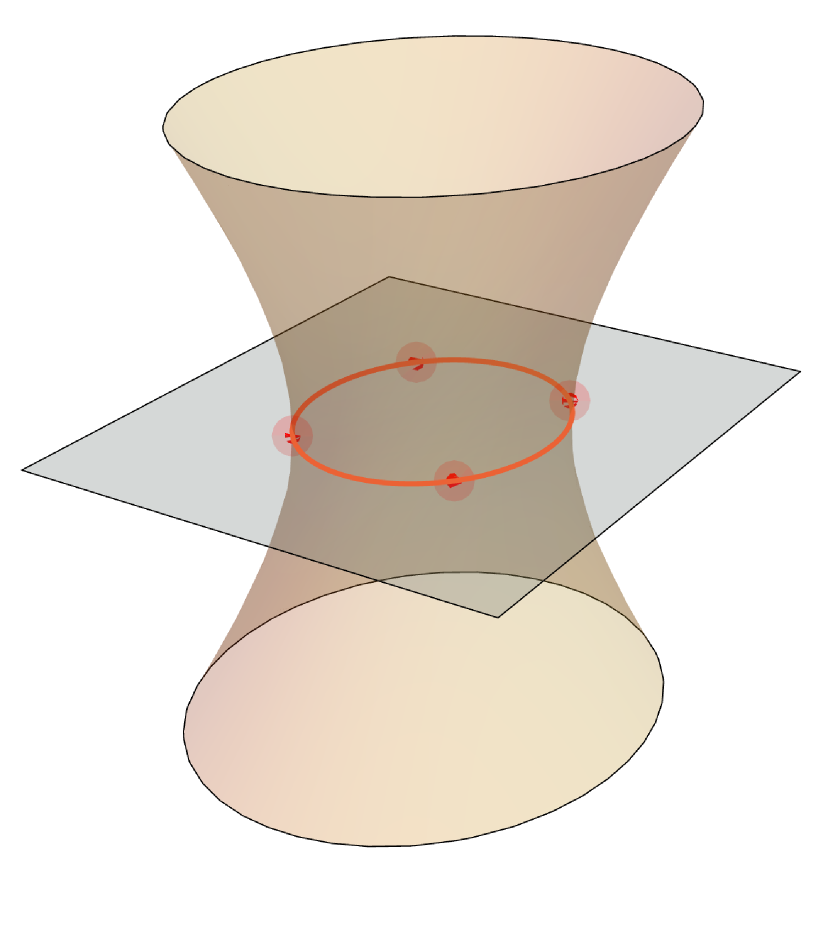
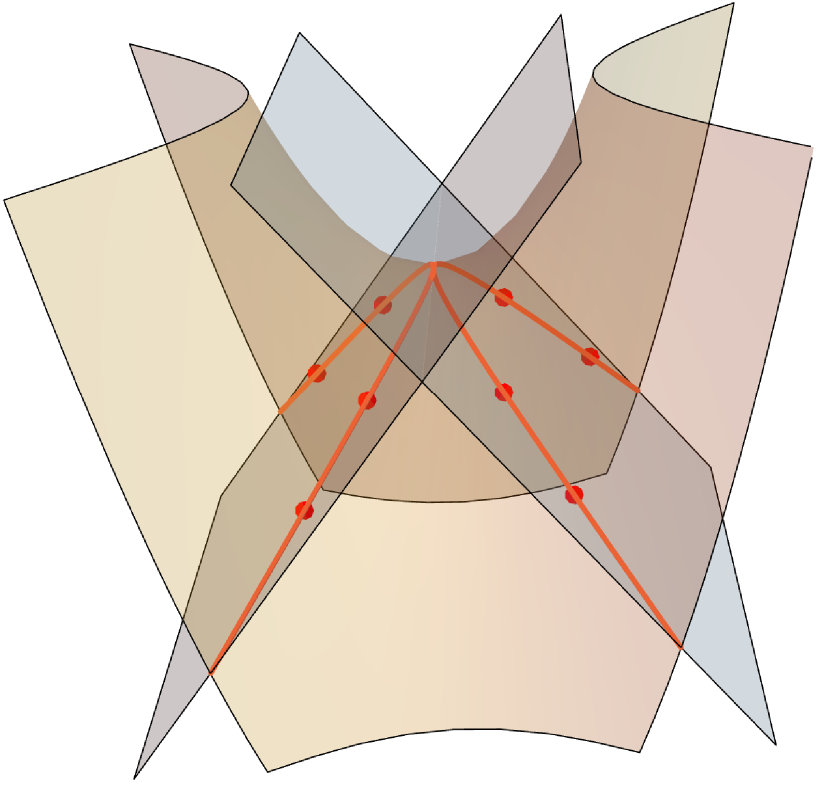
Figure 1: (a) Base set of the surface type A1(1): two quadruples of points on two touching (1,1)-curves in 1×1. (b) Pencil of quadrics through two touching non-coplanar conics

The vertical involution i1 for this pencil can be described by the following equation:

i1(x,y)=(x,y~),(y~+x)(x+y)(y~+x1)(x+y1)=i=14(xai)i=58(xai). (20)

Similarly, the horizontal involution i2 can be described by the following equation:

i2(x,y)=(x~,y),(x~+y)(x+y)(x~+y1)(x+y1)=i=14(y+ai)i=58(y+ai1). (21)

The QRT map is the composition of these two involutions, F=i1i2. The singularity confinement structure of the involutions i1, i2 is as in (11). The symmetric case corresponds to

a2i=a2i1,i=1,2,a2i=1a2i1,i=3,4.

In this case, F=ff, with f=i1σ=σi2 being the QRT root (here σ(x,y)=(y,x)).

3D Painlevé map.

We consider the pencil of quadrics {Pμ} in 3, the Segre lift of the pencil of curves {Cμ}. The pencil {Qλ} is spanned by Q0={X1X2X3X4=0} and Q=P={(X1+X2)(X1+X2X4)=0}:

Qλ={X1X2X3X4λ(X1+X2)(X1+X2X4)=0}. (22)

The base set of the pencil Qλ consists of the two conics, {X1X2X3X4=0,X1+X2=0} and {X1X2X3X4=0,X1+X2=X4}, which have one common (touching) point [0:0:1:0]. This is a pencil of type (v). The intersection of this base set with the base set of the pencil {Pμ} consists of eight points

Si=[ai:bi:aibi:1],i=1,,8,

which are nothing but the lifts of the points si under the Segre embedding.

The matrix Mλ of the quadratic form Qλ:

Mλ=(2λ12λ0λ12λ2λ0λ0001λλ10). (23)

The characteristic polynomial of the pencil {Qλ} is: Δ(λ)=det(Mλ)=14λ, which is not a complete square, and Sing(Qλ)={14,}. We uniformize the Riemann surface of Δ(λ) via

λ=1ν24,Δ(λ)=ν. (24)

Thus, λ(ν)=λ(ν), while Δ(λ) changes its sign as νν. This gives us a double cover of the original pencil branched at λ=1/4 (corresponding to ν=0), and at λ= (corresponding to ν=). The normalizing transformation of Qλ(ν) to the canonical form Q0 can be found as follows:

[X1X2X3X4]=Aν[Y1Y2Y3Y4], (25)

where

Aν=(12ν(1+ν)12ν(1ν)0012ν(1ν)12ν(1+ν)0014ν(1ν2)14ν(1ν2)100001). (26)

Indeed, one immediately verifies that

AνTMλ(ν)Aν=M0.

Now, we are in the position to derive a parametrization of the quadric Qλ:

[X1X2X3X4]=Aν[xyxy1]=[12ν((1+ν)x+(1ν)y)12ν((1ν)x+(1+ν)y)xy+1ν24ν(x+y)1]=:ϕν(x,y). (27)

Observe that this parametrization is neither valid for ν=0 nor for ν=. The pencil-adapted coordinates (x,y,ν) on (the double cover of) 3 are:

x=(1+ν)X1(1ν)X22X4,y=(1+ν)X2(1ν)X12X4, (28)

which have to be supplemented with

λ=1ν24=X1X2X3X4(X1+X2)(X1+X2X4). (29)
Theorem 3.

For any δ{0}, define the Painlevé deformation map corresponding to the translation νν^=ν+2δ by

L:{X^1=X1X4,X^2=X2X4,X^3=X3X4(λ(ν^)λ(ν))Q(X)=X3X4+δ(ν+δ)(X1+X2)(X1+X2X4),X^4=X42.

Then, in pencil-adapted coordinates, the map L acts as follows:

L:(x,y,ν)(x^,y^,ν^),x^=x+δν(x+y),y^=y+δν(x+y),ν^=ν+2δ. (30)

For the latter map, the factorizations (4), (5) are given by

L1=R1:(x,y,ν)(x,y~,ν+δ),L2=R2:(x,y,ν)(x~,y,ν+δ),

where

y~=y+δν(x+y)y~+xy~+xνδ=y+xy+xν, (31)
x~=x+δν(x+y)x~+yx~+yνδ=x+yx+yν. (32)

Relation to the d-Painlevé equation of the surface type A1(1).

We now compute the 3D Painlevé map F~=R1i1L1R2i2L2 in the pencil-adapted coordinates (x,y,ν). For each fixed ν, the intersection curves Qλ(ν)Pμ form a pencil through eight points

si(ν)=(ai,ai),i=1,,4, (33)
si(ν)=(ν12+ai,1+ν2ai),i=5,,8, (34)

which are just the points S1,,S8 (which are, recall, independent of ν) expressed in the pencil-adapted coordinates on Qλ(ν). The curve C(ν), which is the image of the base curve of the pencil {Qλ} in the pencil-adapted coordinates on Qλ(ν), is given by the equation

C(ν)={(x+y)(x+yν)=0}. (35)

The map L sends C(ν) to C(ν+2δ), while the maps L1=R1 and L2=R2 send C(ν) to C(ν+δ). We observe that the map L fixes the (x,y) coordinates of the points of the component {x+y=0} of C(ν), and acts as (x,y)(x+δ,y+δ) on the component {x+y=ν}. This “shift” under the map L is, however, only apparent, as this map fixes the curve 𝒬0𝒬 pointwise. Similarly, the map L1=R1 acts on the second component as (x,y)(x,y+δ), while L2=R2 acts as (x,y)(x+δ,y). These actions are non-trivial in homogeneous coordinates X.

The formulas for the 3D QRT involutions i1, i2 restricted to Qλ(ν) coincide, in the pencil-adapted coordinates, with the original QRT involutions (20) and (21), upon replacing si by si(ν):

i1(x,y)=(x,y~),(y~+x)(x+y)(y~+xν)(x+yν)=i=14(xai)i=58(xaiν12)=:ψ1(x,ν), (36)
i2(x,y)=(x~,y),(x~+y)(x+y)(x~+yν)(x+yν)=i=14(y+ai)i=58(y+ai1+ν2)=:ψ2(y,ν). (37)

In the notation of the equations (7), (8), we have:

(x~+yn)(yn+x)(x~+ynν2n)(yn+xν2n)=ψ2(yn,ν2n), (38)
(y~+xn+1)(xn+1+y)(y~+xn+1ν2n+1)(xn+1+yν2n+1)=ψ1(xn+1,ν2n+1). (39)

It remains to express x,y,x~,y~ in these formulas in terms of xn,yn. According to (7), we have:

L2:(xn,yn,ν2n1/2)(x,yn,ν2n)andR2:(x~,yn,ν2n)(xn+1,yn,ν2n+1/2),

and with expressions (32) for the maps L2, R2, we find:

x+ynx+ynν2n=xn+ynxn+ynν2n1/2, (40)
x~+ynx~+ynν2n=xn+1+ynxn+1+ynν2n+1/2. (41)

Similarly, according to (8), we have:

L1:(xn+1,yn,ν2n+1/2)(xn+1,y,ν2n+1)andR1:(xn+1,y~,ν2n+1)(xn+1,yn+1,ν2n+3/2),

and with expressions (31) for the maps L1, R1, we find:

y+xn+1y+xn+1ν2n+1=xn+1+ynxn+1+ynν2n+1/2, (42)
xn+1+y~xn+1+y~ν2n+1=xn+1+yn+1xn+1+yn+1ν2n+3/2. (43)

Combining equations (38), (39) with (40)–(43) results in the following non-autonomous system:

(xn+1+yn)(xn+yn)(xn+1+ynν2n+1/2)(xn+ynν2n1/2)=ψ2(yn,ν2n), (44)
(xn+1+yn+1)(xn+1+yn)(xn+1+yn+1ν2n+3/2)(xn+1+ynν2n+1/2)=ψ1(xn+1,ν2n+1). (45)

This is nothing but the d-Painlevé equation of the surface type A1(1), as given in [11].

Remark. The symmetric case can be characterized by ψ1(x,ν)=ψ2(x,ν). In this case the latter equations become two instances of

(un+1+un)(un+un1)(un+1+unνn+1/2)(un+un1νn1/2)=ψ1(un,νn), (46)

if we set u2n1=xn, u2n:=yn.

6 From a pencil of type (vi) to the d-Painlevé equation of the surface type D4(1)

By a simple limiting procedure, the results of the previous section lead to similar results for the d-Painlevé equation of the surface type D4(1). We refrain from giving complete details here, and restrict ourselves only to the main results.

2D QRT map.

We consider the QRT map corresponding to the pencil of biquadratic curves {Cμ} through eight points

si=(ai,ai),si+4=(ai+ϵ,ai+ϵ),i=1,,4, (47)

where the points s5,,s8 are infinitely near to s1,,s4, respectively. This pencil contains a reducible curve:

C={(x+y)2=0}. (48)

The vertical involution i1 and the horizontal involution i2 for this pencil can be described by the following equations:

i1(x,y)=(x,y~),1y~+x+1x+y=12i=141xai, (49)
i2(x,y)=(x~,y),1x~+y+1x+y=12i=141y+ai. (50)
Refer to caption
(a)
Refer to caption
(b)
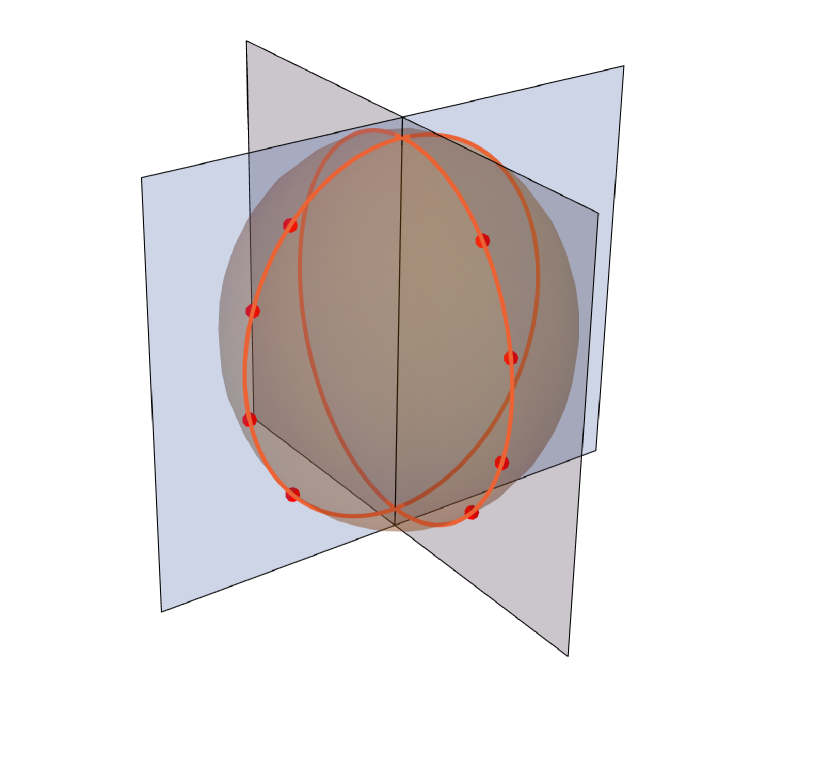
Figure 2: (a) Base set of the surface type D4(1): four double points on a double (1,1)-curve in 1×1. (b) Pencil of quadrics touching along a conic

3D Painlevé map.

We consider the pencil of quadrics {Pμ} in 3 obtained as the Segre lift of the pencil of curves {Cμ}. The pencil {Qλ} is spanned by Q0={X1X2X3X4=0} and Q=P={(X1+X2)2=0}:

Qλ={X1X2X3X4λ(X1+X2)2=0}. (51)

The base set of the pencil Qλ is the double conic {X1X2X3X4=0,X1+X2=0}. This is a pencil of type (vi). The matrix Mλ of the quadratic form Qλ is:

Mλ=(2λ12λ0012λ2λ0000010010). (52)

The characteristic polynomial of the pencil {Qλ} is: Δ(λ)=det(Mλ)=14λ, the same as in Section 5. The normalizing transformation of Qλ(ν) to the canonical form Q0 reads:

[X1X2X3X4]=Aν[Y1Y2Y3Y4], (53)

where

Aν=(12ν(1+ν)12ν(1ν)0012ν(1ν)12ν(1+ν)0000100001). (54)

A parametrization of the quadric Qλ(ν) is given by:

[X1X2X3X4]=Aν[xyxy1]=[12ν((1+ν)x+(1ν)y)12ν((1ν)x+(1+ν)y)xy1]=:ϕν(x,y). (55)

The pencil-adapted coordinates (x,y,ν) on (the double cover of) 3 are:

x=(1+ν)X1(1ν)X22X4,y=(1+ν)X2(1ν)X12X4, (56)

which have to be supplemented with

λ=1ν24=X1X2X3X4(X1+X2)2. (57)
Theorem 4.

For any δ{0}, define the Painlevé deformation map corresponding to the translation νν^=ν+2δ by

L:{X^1=X1X4,X^2=X2X4,X^3=X3X4(λ(ν^)λ(ν))Q(X)=X3X4+δ(ν+δ)(X1+X2)2,X^4=X42.

Then, in pencil-adapted coordinates, the map L acts as follows:

L:(x,y,ν)(x^,y^,ν^),x^=x+δν(x+y),y^=y+δν(x+y),ν^=ν+2δ. (58)

For the latter map, the factorizations (4), (5) are given by

L1=R1:(x,y,ν)(x,y~,ν+δ),L2=R2:(x,y,ν)(x~,y,ν+δ),

where

y~=y+δν(x+y)ν+δy~+x=νy+x, (59)
x~=x+δν(x+y)ν+δx~+y=νx+y. (60)

Computing the 3D Painlevé map F~=R1i1L1R2i2L2 in the pencil-adapted coordinates (x,y,ν), we come to the following non-autonomous system:

ν2n+1/2xn+1+yn+ν2n1/2xn+yn=ν2n2i=141yn+ai, (61)
ν2n+3/2xn+1+yn+1+ν2n+1/2xn+1+yn=ν2n+12i=141xn+1ai. (62)

This can be considered as a d-Painlevé equation of the surface type D4(1), in a realization different from that in [11]. We remark here that the latter equation was put into our scheme in [2, sect. 9], however in the framework of pencils of quadrics with rational (non-branching) generators. There is no obvious relation between these two systems, and it would be desirable to clarify this point.

The symmetric case is characterised by a2i=a2i1, i=1,2. In this case the latter equations become two instances of

νn+1/2un+1+un+νn1/2un+un1=νn(unun2a12+unun2a32), (63)

if we set u2n1=xn, u2n:=yn.

7 From a pencil of type (iv) to the q-Painlevé equation of the surface type A1(1)

2D QRT map.

Consider the QRT map corresponding to the pencil of biquadratic curves through eight points

si=(ai,bi)=(κci,κci1),i=1,,4, (64)
si=(ai,bi)=(ci,ci1),i=5,,8, (65)

with κ0,1. These eight points support a pencil of biquadratic curves if they satisfy the condition

i=14cii=58ci=1i=14aii=58ai=κ4i=14bii=58bi=κ4. (66)

They are symmetric with respect to σ(x,y)=(y,x) if c2i=c2i11, i=1,,4. See Fig. 3 (a).

Refer to caption
(a)
Refer to caption
(b)
Figure 3: (a) Base set of the surface type A1(1): two quadruples of points on two (1,1)-curves (hyperbolas) in 1×1 intersecting at two points (,0) and (0,). (b) Pencil of quadrics through two non-coplanar conics intersecting at two points

This pencil contains a reducible curve consisting of two (1,1)-curves:

C={(xy1)(xyκ2)=0}. (67)

The vertical involution i1 can be described by the following equation:

i1(x,y)=(x,y~),(xy~κ2)(xyκ2)(xy~1)(xy1)=i=14(xκci)i=58(xci). (68)

Similarly, the horizontal involution i2 can be described by the following equation:

i2(x,y)=(x~,y),(x~yκ2)(xyκ2)(x~y1)(xy1)=i=14(yκci1)i=58(yci1). (69)

The QRT map F is the composition of these two involutions, F=i1i2. The singularity confinement structure of the QRT involutions is as in (11). In the symmetric case we have F=f2, with f=i1σ=σi2 being the QRT root.

3D Painlevé map.

As usual, we identify 1×1 with the quadric

Q0={X1X2X3X4=0}3,

via [X1:X2:X3:X4]=[x:y:xy:1]. The points si are lifted to

Si=[ai:bi:aibi:1]={[κci:κci1:κ2:1],i=1,,4,[ci:ci1:1:1],i=5,,8. (70)

We declare Qλ to be spanned by Q0 and Q=P=(X3κ2X4)(X3X4):

Qλ={X1X2X3X4λ(X3κ2X4)(X3X4)=0}. (71)

The base set of the pencil Qλ consists of two conics, {X1X2X3X4=0,X3κ2X4=0} and {X1X2X3X4=0,X3X4=0}, which intersect at two points [0:1:0:0] and [1:0:0:0]. This is a pencil of type (iv).

The matrix Mλ of the quadratic form Qλ:

Mλ=(01001000002λ1+(1+κ2)λ001+(1+κ2)λ2κ2λ) (72)

The characteristic polynomial of the pencil {Qλ} is:

Δ(λ)=det(Mλ)=(1(1+κ2)λ)24κ2λ2=(1(1+κ)2λ)(1(1κ)2λ),

so that Sing(Qλ)={(1+κ)2,(1κ)2,}. This polynomial is not a complete square, and we have to uniformize Δ(λ). The uniformizing variable is ν. However, in the present situation it will be convenient to use w=eν instead, with w{0}. The shift νν+δ will be replaced by wqw with q=eδ. We set

λ=λ(w)=(κw)(1κw)(1κ2)2w. (73)

Then Δ(λ) becomes a square:

Δ(λ)=κ2(1w2)2w2(1κ2)2Δ(λ)=κ(1w2)w(1κ2).

Observe that λ(w)=λ(w1), while Δ(λ) changes its sign under ww1. This gives us a double cover of the original pencil branched at λ=(1+κ)2 (corresponding to w=1), and at λ=(1κ)2 (corresponding to w=1). The point λ= (corresponding to w=0,) is not a branch point. The normalizing transformation of Qλ(X) to the canonical form Q0(Y)=Y1Y2Y3Y4 is achieved by the transformation

[X1X2X3X4]=Aw[Y1Y2Y3Y4], (74)

where one can take

Aw=(10000100001κw1w2w(κw)1w200κwκ(1w2)w(1κw)κ(1w2)). (75)

Indeed, one immediately verifies that

AwTMλ(w)Aw=M0.

Now, we are in the position to derive a parametrization of the quadric Qλ:

[X1X2X3X4]=Aw[xyxy1]=:ϕw(x,y). (76)

Observe that this parametrization is neither valid for w=0 nor for w=. The pencil-adapted coordinates (x,y,w) on (the double cover of) 3 are:

x=(1κw)X3κ(κw)X4(1κ2)X2=w(1κ2)X1κ(1κw)X4(κw)X3, (77)
y=(1κw)X3κ(κw)X4(1κ2)X1=w(1κ2)X2κ(1κw)X4(κw)X4, (78)

which have to be supplemented with

λ=(κw)(1κw)(κ21)2w=X1X2X3X4(X3κ2X4)(X3X4). (79)
Theorem 5.

For any q±1, define the Painlevé deformation map corresponding to the translation ww^=q2w by

L:{X^1=X1X2+(λ(w^)λ(w))(X3X4)(X3κ2X4),X^2=X22,X^3=X2X3,X^4=X2X4, (80)

where λ=λ(w) is given by (73). Then, in pencil-adapted coordinates, the map L acts as follows:

L:x^=q2w21w21x(q21)w2w21y1,y^1=q2w21q2(w21)y1(q21)q2(w21)x,w^=q2w. (81)

For the latter map, the factorizations (4), (5) are given by

L1=R1:(x,y,w)(x,y~,qw),L2=R2:(x,y,w)(x~,y,qw)

where

y~1=q2w21q2(w21)y1(q21)q2(w21)xy~xq2w2y~x1=q2yxw2yx1, (82)

and

x~=q2w21w21x(q21)w2w21y1x~yq2w2x~y1=xyw2xy1. (83)

Relation to the q-Painlevé equation of the surface type A1(1).

We now compute the 3D Painlevé map F~=R1i1L1R2i2L2 in the pencil-adapted coordinates (x,y,w). For each fixed w, the intersection curves Qλ(w)Pμ form a pencil through eight points

si(w)=(wci,wci1),i=1,,4, (84)
si(w)=(ci,ci1),i=5,,8, (85)

which are just the points S1,,S8 expressed in the pencil-adapted coordinates on Qλ(w). The formulas for the 3D QRT involutions i1, i2 restricted to Qλ(w) coincide, in the pencil-adapted coordinates, with the original QRT involutions (68) and (69), upon replacing κ by w, and si by si(w):

i1(x,y)=(x,y~),(xy~w2)(xyw2)(xy~1)(xy1)=i=14(xwci)i=58(xci), (86)
i2(x,y)=(x~,y),(x~yw2)(xyw2)(x~y1)(xy1)=i=14(ywci1)i=58(yci1). (87)

In the notation of the equations (7), (8), the latter two equations read:

(x~ynw2n2)(xynw2n2)(x~yn1)(xyn1)=i=14(ynw2nci1)i=58(ynci1), (88)
(y~xn+1w2n+12)(yxn+1w2n+12)(y~xn+11)(yxn+11)=i=14(xn+1w2n+1ci)i=58(xn+1ci), (89)

where

w2n1/2=q1w2n,w2n+1/2=qw2n. (90)

According to (7), we have:

L2:(xn,yn,w2n1/2)(x,yn,w2n)andR2:(x~,yn,w2n)(xn+1,yn,w2n+1/2).

With expressions (83) for the maps L2, R2, we find:

xynw2n2xyn1=xnynw2nw2n1xnyn1, (91)
x~ynw2n2x~yn1=xn+1ynw2n+1w2nxn+1yn1. (92)

Similarly, according to (8), we have:

L1:(xn+1,yn,w2n+1/2)(xn+1,y,w2n+1)andR1:(xn+1,y~,w2n+1)(xn+1,yn+1,w2n+3/2),

and with expressions (82) for the maps L1, R1, we find:

q2xn+1yw2n+12xn+1y1=xn+1ynw2n+1w2nxn+1yn1, (93)
q2y~xn+1w2n+12y~xn+11=xn+1yn+1w2n+2w2n+1xn+1yn+11. (94)

Combining equations (88), (89) with (91)–(94) results in the following non-autonomous system:

(xn+1ynw2n+1w2n)(xnynw2nw2n1)(xn+1yn1)(xnyn1)=i=14(ynw2nci1)i=58(ynci1), (95)
(yn+1xn+1w2n+2w2n+1)(ynxn+1w2n+1w2n)(yn+1xn+11)(ynxn+11)=i=14(xn+1w2n+1ci)i=58(xn+1ci). (96)

This is the q-Painlevé equation of the surface type A1(1) , as given in [11]. In the symmetric case, if c2i=c2i11, i=1,,4, these equations become two instances of

(un+1unwn+1wn)(unun1wnwn1)(un+1un1)(unun11)=i=14(unwnci)i=58(unci). (97)

8 From a pencil of type (iii) to the d-Painlevé equation of the surface type A0(1)

2D QRT map.

We consider the QRT map corresponding to the pencil of biquadratic curves through eight points si=(ai,bi), i=1,,8, where

ai=zi(ziκ1),bi=zi(ziκ2).

These eight points support a pencil of biquadratic curves if they satisfy the condition

i=18zi=2(κ1+κ2).

They belong to the curve with the equation

(xy)2=(κ2κ1)(κ2xκ1y).

This is a biquadratic curve in 1×1 with a cusp point at (,), see Fig. 4 (a).

Refer to caption
(a)
Refer to caption
(b)
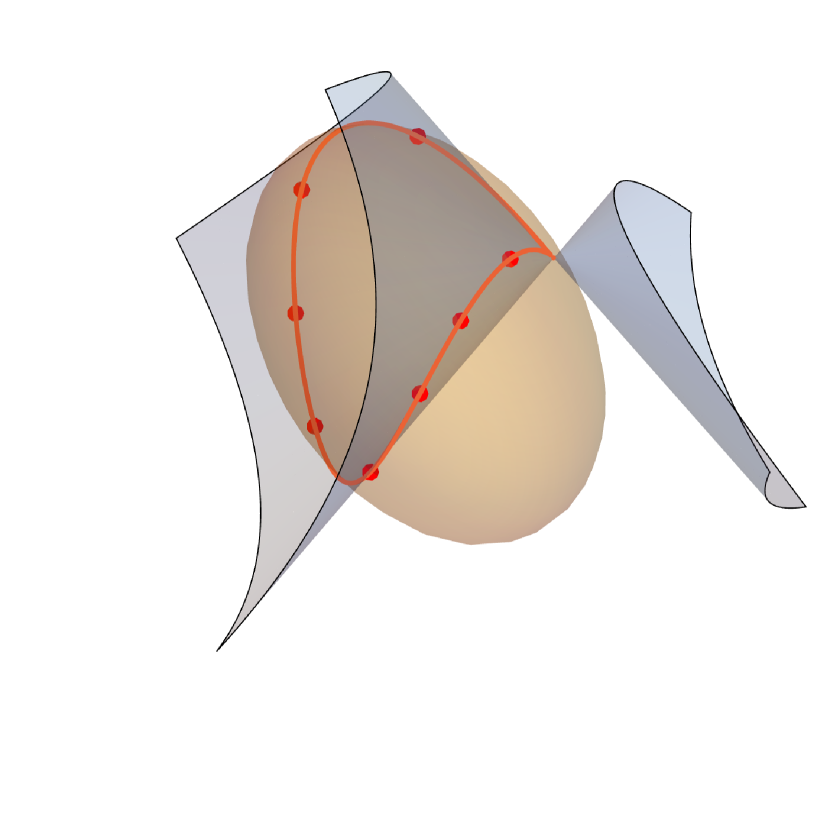
Figure 4: (a) Base set of the surface type A0(1): eight points on a cuspidal (2,2)-curve in 1×1. (b) Pencil of quadrics through cuspidal spatial quartic in 3

The vertical involution i1 can be described by the following equation:

i1(x,y)=(x,y~),
(y~ξ(ξκ2))(yξ(ξκ2))(y~(ξκ1)(ξκ1+κ2))(y(ξκ1)(ξκ1+κ2))=U(ξ)U(κ1ξ),x=ξ(ξκ1). (98)

Here we use the abbreviation

U(z)=i=18(zzi). (99)

Formula (8) is understood as follows. Written as a polynomial in ξ, it is anti-symmetric with respect to ξκ1ξ. Upon division by ξ2κ1, the resulting polynomial is symmetric and therefore it can be actually expressed as a polynomial in x=ξ(ξκ1). This defines i1 as a birational involution (its symmetry w.r.t. yy~ is obvious).

Similarly, the horizontal involution i2 can be described by the following equation:

i2(x,y)=(x~,y),
(x~η(ηκ1))(xη(ηκ1))(x~(ηκ2)(ηκ2+κ1))(x(ηκ2)(ηκ2+κ1))=U(η)U(κ2η),y=η(ηκ2). (100)

The QRT map F is the composition of these two involutions, F=i1i2. The eight points s1,,s8 in 1×1 serve as the indeterminacy set for i1 and for i2. The singularity confinement structure is as in (11).

Remark. In what follows, we restrict ourselves to the case κ1+κ2=0. This restriction is not essential, but will allow us to shorten some of the formulas. Thus, from now on we set

κ1=κ,κ2=κ. (101)

If, additionally, the points zi satisfy the condition

zi+4=zi,i=1,,4, (102)

then the QRT involutions admits a symmetry i1=σi2σ, where σ(x,y)=(y,x), so that one can introduce the QRT root f=i1σ=σi2, such that F=ff.

3D Painlevé map.

As usual, we identify 1×1 with the quadric Q0={X1X2X3X4=0}3 via [X1:X2:X3:X4]=[x:y:xy:1]. The points si are lifted to

Si=[ai:bi:aibi:1].

We declare Qλ to be spanned by Q0 and Q=P=(X1X2)22κ2(X1+X2)X4:

Qλ={X1X2X3X4λ((X1X2)22κ2(X1+X2)X4)=0}. (103)

The base set of the pencil Qλ is a cuspidal space curve of degree 4, {X1X2X3X4=0,(X1X2)22κ2(X1+X2)X4=0}, with the cusp at [0:0:1:0]. This is a pencil of type (iii).

The matrix Mλ of the quadratic form Qλ:

Mλ=(2λ1+2λ02λκ21+2λ2λ02λκ200012λκ22λκ210) (104)

The characteristic polynomial of the pencil {Qλ} is: Δ(λ)=det(Mλ)=1+4λ, so that Sing(Qλ)={14,}. We set

λ=ν214,Δ(λ)=ν. (105)

Thus, λ(ν)=λ(ν), while Δ(λ) changes its sign as νν. This gives us a double cover of the original pencil branched at ν=0, corresponding to λ=1/4, and at ν=, corresponding to λ=. The normalizing transformation of Qλ to the canonical form Q0 can be found as follows:

[X1X2X3X4]=Aν[Y1Y2Y3Y4], (106)

where

Aν=(12ν(ν+1)12ν(ν1)0012ν(ν1)12ν(ν+1)00κ22(ν21)κ22(ν21)100001). (107)

Indeed, one immediately verifies that

AνTMλ(ν)Aν=M0.

Now, we are in the position to derive a parametrization of the quadric Qλ(ν):

[X1X2X3X4]=Aν[xyxy1]=[12ν((ν+1)x+(ν1)y)12ν((ν1)x+(ν+1)y)xy+κ22(ν21)(x+y)1]=:ϕν(x,y). (108)

Observe that this parametrization is neither valid for ν=0 nor for ν=. The pencil-adapted coordinates (x,y,ν) on (the double cover of) 3 are:

x=(ν+1)X1(ν1)X22X4,y=(ν+1)X2(ν1)X12X4, (109)

which have to be supplemented with

λ=ν214=X1X2X3X4(X1X2)22κ2(X1+X2)X4. (110)

The degenerate quadrics for ν= and for ν=0 are cones.

Theorem 6.

For any δ{0}, define the Painlevé deformation map corresponding to the translation νν^=ν+2δ by

L:{X^1=X1X4,X^2=X2X4,X^3=X3X4(λ(ν^)λ(ν))Q(X)=X3X4β(ν+β)(X1X2)2+2κ2β(ν+β)(X1+X2)X4,X^4=X42.

Then, in pencil-adapted coordinates, the map L acts as follows:

L:(x,y,ν)(x^,y^,ν^),x^=x+δ(xy)ν,y^=y+δ(yx)ν,ν^=ν+2δ. (111)

For the latter map, the factorizations (4), (5) are given by

L1=R1:(x,y,ν)(x,y~,ν+δ),y~=y+δν(yx), (112)
L2=R2:(x,y,ν)(x~,y,ν+δ),x~=x+δν(xy). (113)

Relation to the d-Painlevé equation of the surface type A0(1).

In the pencil-adapted coordinates (x,y,ν), for each fixed ν, the intersection curves Qλ(ν)Pμ form the pencil through the points

si(ν)=(ai(ν),bi(ν))=(zi(zi+κν),zi(ziκν)),i=1,,8, (114)

which are just the points Si expressed in the pencil-adapted coordinates on Qλ(ν). Thus, the 3D QRT involutions i1, i2 act on each quadric Qλ(ν) in the pencil-adapted coordinates via formulas which are obtained from the corresponding 2D formulas by replacing κ by κν:

i1(x,y)=(x,y~),
(y~ξ(ξκν))(yξ(ξκν))(y~(ξ+κν)(ξ+2κν))(y(ξ+κν)(ξ+2κν))=U(ξ)U(κνξ),x=ξ(ξ+κν), (115)
i2(x,y)=(x~,y),
(x~η(η+κν))(xη(η+κν))(x~(ηκν)(η2κν))(x(ηκν)(η2κν))=U(η)U(κνη),y=η(ηκν). (116)

In notations of (7), (8), the latter two equations take the following form:

(x~η(η+κν2n))(xη(η+κν2n))(x~(ηκν2n)(η2κν2n))(x(ηκν2n)(η2κν2n))=U(η)U(κν2nη),
yn=η(ηκν2n), (117)
(y~ξ(ξκν2n+1))(yξ(ξκν2n+1))(y~(ξ+κν2n+1)(ξ+2κν2n+1))(y(ξ+κν2n+1)(ξ+2κν2n+1))=U(ξ)U(κν2n+1ξ),
xn+1=ξ(ξ+κν2n+1). (118)

Recall that here

ν2n+1=ν2n+1/2+δ=ν2n+2δ.

To express in (8) the variables x, x~ through xn, yn, we observe that

L2:(xn,yn,ν2n1/2)(x,yn,ν2n),R2:(x~,yn,ν2n)(xn+1,yn,ν2n+1/2)

can be written, according to (113), as follows:

x=xn+δν2n1/2(xnyn),resp.xn+1=x~+δν2n(x~yn).

A simple computation confirms that these relations are equivalent to

xη(η+κν2n)x(ηκν2n)(η2κν2n)=xnη(η+κν2n1)xn(ηκν2n)(ηκν2nκν2n1),yn=η(ηκν2n), (119)
x~η(η+κν2n)x~(ηκν2n)(η2κν2n)=xn+1η(η+κν2n+1)xn+1(ηκν2n)(ηκν2n+1κν2n),yn=η(ηκν2n). (120)

Similarly, to express in (8) the variables y, y~ through xn+1, yn, we observe that

L1:(xn+1,yn,ν2n+1/2)(xn+1,y,ν2n+1),R1:(xn+1,y~,ν2n+1)(xn+1,yn+1,ν2n+3/2),

which, according to (112), can be put as follows:

y=yn+δν2n+1/2(ynxn+1),yn+1=y~+δν2n+1(y~xn+1).

Again, these relations are equivalent to

yξ(ξκν2n+1)y(ξ+κν2n+1)(ξ+2κν2n+1)=ynξ(ξκν2n)yn(ξ+κν2n+1)(ξ+κν2n+1+κν2n),
xn+1=ξ(ξ+κν2n+1) (121)
y~ξ(ξκν2n+1)y~(ξ+κν2n+1)(ξ+2κν2n+1)=yn+1ξ(ξκν2n+2)yn+1(ξ+κν2n+1)(ξ+κν2n+2+κν2n+1),
xn+1=ξ(ξ+κν2n+1). (122)

Substituting (119)–(8) into (8), (8), we arrive at the following system of non-autonomous difference equations for the variables xn,yn :

(xn+1η(η+κν2n+1))(xnη(η+κν2n1))(xn+1(ηκν2n)(ηκν2n+1κν2n))(xn(ηκν2n)(ηκν2nκν2n1))
=U(η)U(κν2nη),yn=η(ηκν2n), (123)
(yn+1ξ(ξκν2n+2))(ynξ(ξκν2n))(yn+1(ξ+κν2n+1)(ξ+κν2n+2+κν2n+1))(yn(ξ+κν2n+1)(ξ+κν2n+1+κν2n))
=U(ξ)U(κν2n+1ξ),xn+1=ξ(ξ+κν2n+1). (124)

This is the d-Painlevé equation of the surface type A0(1), as given in [20], [11].

Remark. In the symmetric situation, when U(z)=U(z), the system (8), (8) can be interpreted as a one-field second order difference equation, with xn=u2n1 and yn=u2n. To see this, one should make the change ξξ in equation (8), after which it matches (8).

9 From a pencil of type (ii) to the q-Painlevé equation of the surface type A0(1)

2D QRT map.

We consider the QRT map corresponding to the pencil of biquadratic curves through eight points si=(ai,bi), where

ai=zi+κ1zi,bi=1zi+ziκ2,i=1,,8.

These eight points support a pencil of biquadratic curves if they satisfy the condition

i=18zi=κ12κ22.

They belong to the curve with the equation

(xκ2y)(yκ11x)=(κ1κ2)1(κ1κ2)2.

This is a biquadratic curve in 1×1 with a simple node at (,), see Fig. 5 (a).

Refer to caption
(a)
Refer to caption
(b)
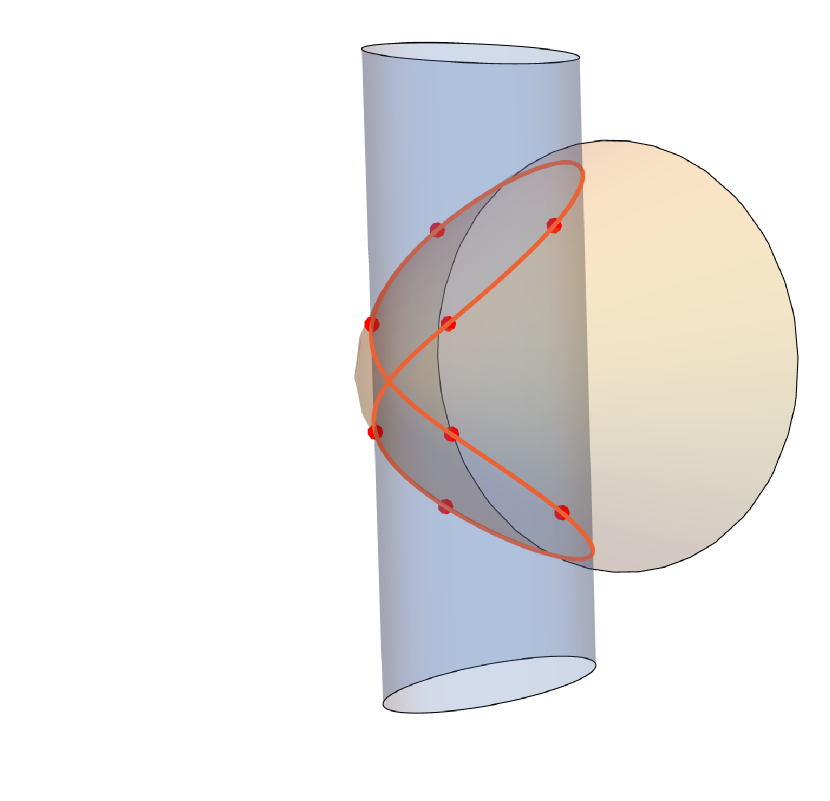
Figure 5: (a) Base set of the surface type A0(1): eight points on a nodal (2,2)-curve in 1×1. (b) Pencil of quadrics through a nodal spatial quartic in 3

The vertical involution i1 can be described by the following equation:

i1(x,y)=(x,y~),(y~1ξξκ2)(y1ξξκ2)(y~ξκ1κ1κ2ξ)(yξκ1κ1κ2ξ)=U(ξ)U(κ1ξ),x=ξ+κ1ξ. (125)

Here we use the abbreviation

U(z)=z4i=18(zzi). (126)

Formula (125) is understood as follows. Written as a Laurent polynomial in ξ, it is anti-symmetric with respect to ξκ1/ξ. Upon division by ξκ1/ξ, the resulting Laurent polynomial is symmetric and therefore it can be actually expressed as a polynomial in x=ξ+κ1/ξ. This defines i1 as a birational involution (its symmetry w.r.t. yy~ is obvious).

Similarly, the horizontal involution i2 can be described by the following equation:

i2(x,y)=(x~,y),(x~ηκ1η)(xηκ1η)(x~κ2ηκ1ηκ2)(xκ2ηκ1ηκ2)=U(η)U(κ2η),y=1η+ηκ2. (127)

The eight points s1,,s8 in 1×1 serve as the indeterminacy set for i1 and for i2. The singularity confinement structure is as in (11). The QRT map F is the composition of these two involutions, F=i1i2.

Remark. In what follows, we restrict ourselves to the case κ1κ2=1. This restriction is not essential, but will allow us to shorten some of the formulas. Thus, from now on we set in this section

κ1=1κ,κ2=κ. (128)

If, additionally, the points zi satisfy the condition

zi+4=zi1,i=1,,4, (129)

then the QRT involutions admits a symmetry i1=σi2σ, where σ(x,y)=(y,x), so that one can introduce the QRT root f=i1σ=σi2, such that F=ff.

3D Painlevé map.

As usual, we identify 1×1 with the quadric Q0={X1X2X3X4=0}3 via [X1:X2:X3:X4]=[x:y:xy:1]. The points si are lifted to

Si=[ai:bi:aibi:1].

We declare Qλ to be spanned by Q0 and

Q=P=κ(X12+X22)(1+κ2)X1X2+(κκ1)2X42. (130)

The base set of the pencil Qλ is a nodal space curve {Q0=0,P=0} of degree 4, with the node at [0:0:1:0]. This is a pencil of type (ii).

The matrix Mλ of the quadratic form Qλ:

Mλ=(2κλ1+(1+κ2)λ001+(1+κ2)λ2κλ0000010012(κκ1)2λ). (131)

The characteristic polynomial of the pencil {Qλ} is:

Δ(λ)=det(Mλ)=(1+(1+κ2)λ)24κ2λ2=(1+(1+κ)2λ)(1+(1κ)2λ),

so that Sing(Qλ)={(1+κ)2,(1κ)2,}. This polynomial is not a complete square, and we have to uniformize Δ(λ). The uniformizing variable is ν. As in Sect. 7, it will be convenient to use w=eν instead, with w{0}. We set

λ=λ(w)=(κw)(1κw)(1κ2)2w. (132)

Then Δ(λ) becomes a square:

Δ(λ)=κ2(1w2)2w2(1κ2)2Δ(λ)=κ(1w2)w(1κ2).

Observe that λ(w)=λ(w1), while Δ(λ) changes its sign under ww1. This gives us a double cover of the original pencil branched at λ=(1+κ)2 (corresponding to w=1), and at λ=(1κ)2 (corresponding to w=1). The point λ= is not a branch point (it corresponds to w=0,). The normalizing transformation of Qλ(X) to the canonical form Q0(Y)=Y1Y2Y3Y4 is achieved by the transformation

[X1X2X3X4]=Aw[Y1Y2Y3Y4], (133)

where one can take

Aw=(w(1κw)κ(1w2)w(κw)κ(1w2)00w(κw)κ(1w2)w(1κw)κ(1w2)0000wκ(1κw)(κw)κ2w0001). (134)

Indeed, one immediately verifies that

AwTMλ(w)Aw=wκM0.

There follows a parametrization of the quadric Qλ(w):

[X1X2X3X4]=Aw[xyxy1]=:ϕw(x,y). (135)

This parametrization is neither valid for w=0 nor for w=. The pencil-adapted coordinates (x,y,w) on (the double cover of) 3 are:

x=κw(1κw)X1(κw)X2(1κ2)X4,y=κw(1κw)X2(κw)X1(1κ2)X4, (136)

which have to be supplemented with

λ=(κw)(1κw)(κ21)2w=X1X2X3X4κX12+κX22(1+κ2)X1X2+(κκ1)2X42. (137)
Theorem 7.

For any q±1, define the Painlevé deformation map corresponding to the translation ww^=q2w by

L:{X^1=X1X4,X^2=X2X4,X^3=X3X4(λ(w^)λ(w))Q(X),X^4=X42, (138)

where λ=λ(w) is given by (132), and Q(X) is given in (130). Then, in pencil-adapted coordinates, the map L acts as follows:

L:x^=x+1q2w21(xwy),y^=y+1q2w21(ywx),w^=q2w. (139)

For the latter map, the factorizations (4), (5) are given by

L1:(x,y,w)(x,y~,qw),y~=y+1q2w21(yqwx), (140)
R1:(x,y,w)(x,y~,qw),y~=y+1q2w21(ywx), (141)
L2:(x,y,w)(x~,y,qw),x~=x+1q2w21(xqwy), (142)
R2:(x,y,w)(x~,y,qw),x~=x+1q2w21(xwy). (143)

Relation to the q-Painlevé equation of the surface type A0(1).

In the pencil-adapted coordinates (x,y,w), for each fixed w, the intersection curves Qλ(w)Pμ form the pencil through the points

si(w)=(ai(w),bi(w))=(zi+1wzi,1zi+ziw),i=1,,8, (144)

which are just the points Si expressed in the pencil-adapted coordinates on Qλ(w). Thus, the 3D QRT involutions i1, i2 act on each quadric Qλ(w) in the pencil-adapted coordinates via formulas which are obtained from the corresponding 2D formulas by replacing κ by w:

i1(x,y)=(x,y~),(y~1ξξw)(y1ξξw)(y~wξ1w2ξ)(ywξ1w2ξ)=U(ξ)U(1wξ),x=ξ+1wξ, (145)
i2(x,y)=(x~,y),(x~η1wη)(xη1wη)(x~wηηw2)(xwηηw2)=U(η)U(wη),y=1η+ηw. (146)

In notations of (7), (8), this takes the form

(x~η1w2nη)(xη1w2nη)(x~w2nηηw2n2)(xw2nηηw2n2)=U(η)U(w2nη),yn=1η+ηw2n, (147)
(y~1ξξw2n+1)(y1ξξw2n+1)(y~w2n+1ξ1w2n+12ξ)(yw2n+1ξ1w2n+12ξ)=U(ξ)U(1w2n+1ξ),xn+1=ξ+1w2n+1ξ. (148)

Here, recall,

w2n+1=qw2n+1/2=q2w2n. (149)

To express in (147) the variables x, x~ through xn, yn, we observe that

L2:(xn,yn,w2n1/2)(x,yn,w2n),R2:(x~,yn,w2n)(xn+1,yn,w2n+1/2).

According to (142), (143), we find:

x=xn+1q2w2n1/221(xnqw2n1/2yn),xn+1=x~+1q2w2n21(x~w2nyn).

A straightforward computation confirms that these equations are equivalent to

xη1w2nηxw2nηηw2n2=xnη1w2n1ηxnw2nηηw2nw2n1,yn=1η+ηw2n, (150)
x~η1w2nηx~w2nηηw2n2=xn+1η1w2n+1ηxn+1w2nηηw2nw2n+1,yn=1η+ηw2n. (151)

Similarly, to express in (148) the variables y, y~ through xn+1, yn, we observe that

L1:(xn+1,yn,w2n+1/2)(xn+1,y,w2n+1),R1:(xn+1,y~,w2n+1)(xn+1,yn+1,w2n+3/2).

According to (140), (141), we find:

y=yn+1q2w2n+1/221(ynqw2n+1/2xn+1),yn+1=y~+1q2w2n+121(y~w2n+1xn+1).

These equations are equivalent to

y1ξξw2n+1yw2n+1ξ1w2n+12ξ=yn1ξξw2nynw2n+1ξ1w2n+1w2nξ,xn+1=ξ+1w2n+1ξ, (152)
y~1ξξw2n+1y~w2n+1ξ1w2n+12ξ=yn+11ξξw2n+2yn+1w2n+1ξ1w2n+2w2n+1ξ,xn+1=ξ+1w2n+1ξ. (153)

Substitute (150)–(153) into (147), (148). This results in the following system of non-autonomous difference equations for the variables xn,yn:

(xn+1η1w2n+1η)(xnη1w2n1η)(xn+1w2nηηw2nw2n+1)(xnw2nηηw2nw2n1)=U(η)U(w2nη),yn=1η+ηw2n, (154)
(yn+11ξξw2n+2)(yn1ξξw2n)(yn+1w2n+1ξ1w2n+2w2n+1ξ)(ynw2n+1ξ1w2n+1w2nξ)=U(ξ)U(1w2n+1ξ),
xn+1=ξ+1w2n+1ξ. (155)

This is the q-Painlevé equation of the surface type A0(1), as given in [20], [11].

Remark. In the symmetric situation, when U(z)=U(z1), the system (154), (9) can be interpreted as a one-field second order difference equation, with xn=u2n1 and yn=u2n. To see this, one should make in equation (9) the change ξξ1, after which it matches (154).

10 Conclusions

In this paper, we carried out the largest part of the task left open in [2], namely extended our novel approach to the pencils for which the generators through a point X3 depend on X in a non-rational (branching) way. The only case left open for a further investigation is the pencil of the generic type (i), associated (in our scheme) with the elliptic Painlevé equation. Also the problem of an interpretation of the isomonodromic property of discrete Painlevé equations within our scheme remains open and is left for the future research. Finally, it will be important to extend the scheme of the present paper to discrete Painlevé equations corresponding to further translations in the corresponding affine Weyl symmetry groups. A path to this goal (via additional geometric involutions related to pencils and nets of quadrics) was sketched in the concluding remarks of [2]. The first step towards this goal (in the two-dimensional framework) has been performed in [3].

Acknowledgments

This research was supported (till June 2024) by the DFG Collaborative Research Center TRR 109 “Discretization in Geometry and Dynamics”.

References

  • [1] J. Alonso, Yu. B. Suris, K. Wei. A three-dimensional generalization of QRT maps. J. Nonlinear Sci. 33 (2023), 117.
  • [2] J. Alonso, Yu. B. Suris, K. Wei. Discrete Painlevé equations and pencils of quadrics in 3. arXiv:2403.11349 [nlin.SI]
  • [3] J. Alonso, Yu.B. Suris. Geometry of autonomous discrete Painlevé equations related to the Weyl group W(E8(1)). arXiv:2512.18288 [nlin.SI].
  • [4] M. P. Bellon, C.-M. Viallet. Algebraic entropy. Commun. Math. Phys. 204 (1999), 425–437.
  • [5] A.S. Carstea, A. Dzhamay, T. Takenawa. Fiber-dependent deautonomization of integrable 2D mappings and discrete Painlevé equations. J. Phys. A. Math. Theor. 50 (2017), 405202.
  • [6] E. Casas-Alvero. Analytic projective geometry. EMS Textbooks in Mathematics. Zürich: European Mathematical Society (2014).
  • [7] J.J. Duistermaat. Discrete Integrable Systems. QRT Maps and Elliptic Surfaces. Springer Monographs in Mathematics. Springer, New York (2010).
  • [8] B. Grammaticos, A. Ramani. Discrete Painlevé equations: a review. In: Grammaticos, B. et al. (eds.), Discrete integrable systems, Proceedings of the international CIMPA school, Pondicherry, India, February 2–14, 2003. Lecture Notes in Physics 644 (2004), 245–321.
  • [9] B. Grammaticos, A. Ramani, V. Papageorgiou. Do integrable mappings have the Painlevé property? Phys. Rev. Lett. 67, No. 14 (1991) 1825–1828.
  • [10] N. Joshi. Discrete Painlevé equations. CBMS Regional Conference Series in Mathematics 131. Providence, RI: American Mathematical Society (2019).
  • [11] K. Kajiwara, M. Noumi, Y. Yamada. Geometric aspects of Painlevé equations. J. Phys. A. Math. Theor. 50 (2017), 073001.
  • [12] T. Mase, R. Willox, A. Ramani, and B. Grammaticos. Singularity confinement as an integrability criterion, J. Phys. A 52 (2019), 205201.
  • [13] M. Noumi, S. Tsujimoto, Y. Yamada. Padé interpolation for elliptic Painlevé equation. In: Symmetries, Integrable Systems and Representations, Ed. K. Iohara et al, Springer Proceedings in Mathematics and Statistics 40 (2013), pp. 463–482.
  • [14] G.R.W. Quispel, J.A.G. Roberts, C.J.Thompson. Integrable mappings and soliton equations. Phys. Lett. A 126, no. 7 (1988) 419–421.
  • [15] G.R.W. Quispel, J.A.G. Roberts, C.J.Thompson. Integrable mappings and soliton equations II. Phys. D 34, no. 1–2 (1989) 183–192.
  • [16] A. Ramani, B. Grammaticos, J. Hietarinta. Discrete versions of the Painlevé equations. Phys. Rev. Lett. 67, No. 14 (1991) 1829–1832.
  • [17] M. Reid. The complete intersection of two or more quadrics. Thesis, Cambridge, 1972. http://homepages.warwick.ac.uk/masda/3folds/qu.pdf
  • [18] H. Sakai. Rational surfaces associated with affine root systems and geometry of the Painlevé equations. Commun. Math. Phys. 220 (2001), 165–229.
  • [19] T. Takenawa. Discrete dynamical systems associated with the configuration space of 8 points in 3(). Commun. Math. Phys. 246, No. 1 (2004) 19–42.
  • [20] Y. Yamada. A simple expression for discrete Painlevé equations. RIMS Kôkyûroku Bessatsu B47 (2014), pp. 87–95 .
  • [21] Y. Yamada. Theory and applications of the elliptic Painlevé equation. In: Partition Functions and Automorphic Forms, Eds. V.A. Gritsenko and V.P. Spiridonov, Moscow Lectures 5 (2020) pp. 369–415.